What REALLY Happened to Britain’s Medium Mark A Whippet Tanks After WW1 D
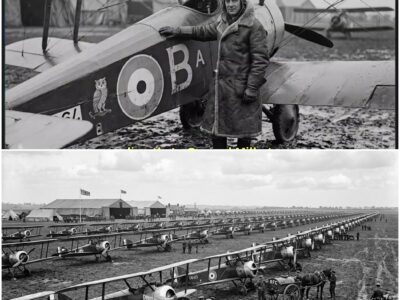
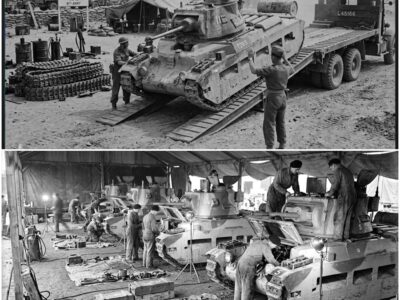
British officers stood at the tank sheds of the central workshops near Erin, France in the weeks after the guns fell silent about to take stock of a machine that had terrified German infantry only months before. Behind the corrugated doors sat rows of medium Mark A tanks, low, boxy, curiously fast for their size, their fixed turrets bristling with Hotchkiss machine guns.
These were the Whippets, and whilst the world remembers the lumbering Mark IV as the tank that broke the trench deadlock, it was this smaller, quicker cousin that the tank core itself regarded as its most lethal weapon. Fewer than 200 had ever been built, yet by the war’s end they had inflicted more German casualties than any other British tank design.
Now, with the armistice signed and the front gone quiet, nobody was entirely certain what should happen to them. Some officers wanted them scrapped as surplus machinery, a drain on scarce steel and workshop space. Others insisted they represented the future of mechanized warfare and ought to be preserved, studied, and put to further use wherever the empire still needed muscle.
That argument would shape the Whippet’s fate for the next decade, sending survivors to the bogs of Ireland, the frozen steppe of southern Russia, the training grounds of Imperial Japan, and eventually to a small handful of museum halls where they remain today. By 14th of March 1919, official figures recorded that 200 Whippets had been produced across the war.
Built by William Tritton’s works at Fosters of Lincoln to a design he had first proposed as a chaser tank as early as December 1916. Attrition in the fighting of 1918, particularly around Amiens and Bapaume, had already reduced that number considerably before the armistice was even signed on 11th of November 1918.
What remained afterwards was a mixed inventory, machines still assigned to operational battalions, others sitting in repair depots awaiting parts, and a small number that had fallen into enemy hands during the fighting, and were now themselves subject to recovery or disposal. German forces had captured fewer than 15 Whippets during the war, only two of which were kept in running order.
These were designated Beutepanzer A and used for training and evaluation before at least one was pressed into service by Freikorps units during the German Revolution of 1918 to 1919. A strange postscript in which a captured British tank fought in a German civil conflict months after the armistice that supposedly ended such fighting.
For the allies, the pressing question was not destruction but deployment because unlike the immense high seas fleet or the Zeppelin sheds of the German naval bases, the Whippet was not a defeated enemy’s weapon to be divided as spoils. It was a British asset whose future the war office alone would decide, subject only loosely to the wider disarmament mood that would later be codified in the Treaty of Versailles for German equipment specifically.
That distinction meant the Whippet’s post-war story ran differently from most of the equipment discussed in this series. Rather than a race between rival powers to seize enemy technology, what followed was a quieter argument within the British military establishment itself about whether a proven weapon still had a role in an army rapidly demobilizing and shrinking its budgets.
Britain’s own disposal of the Whippet tells that story most clearly. The Tank Corps, soon renamed the Royal Tank Corps, retained a portion of its Whippet fleet for operational duties rather than immediate scrapping. And the most significant deployment came not against a foreign enemy but within the United Kingdom itself.
During the Anglo-Irish War, which erupted in January 1919 and ran through 1921, the 17th Battalion of the Royal Tank Corps operated Whippits in support of Crown forces attempting to suppress Republican activity. Their role there was limited and controversial, used chiefly for patrol duties, escort work, and shows of force in towns such as Dublin rather than for the kind of mobile exploitation warfare for which William Tritton had originally designed them.
Military planners in London had, in truth, always envisioned the Whippet working alongside cavalry, exploiting gaps torn open by heavier tanks. In Ireland’s narrow lanes and built-up streets, that doctrine proved almost entirely irrelevant. And the tanks instead became symbols of occupation more than instruments of maneuver warfare.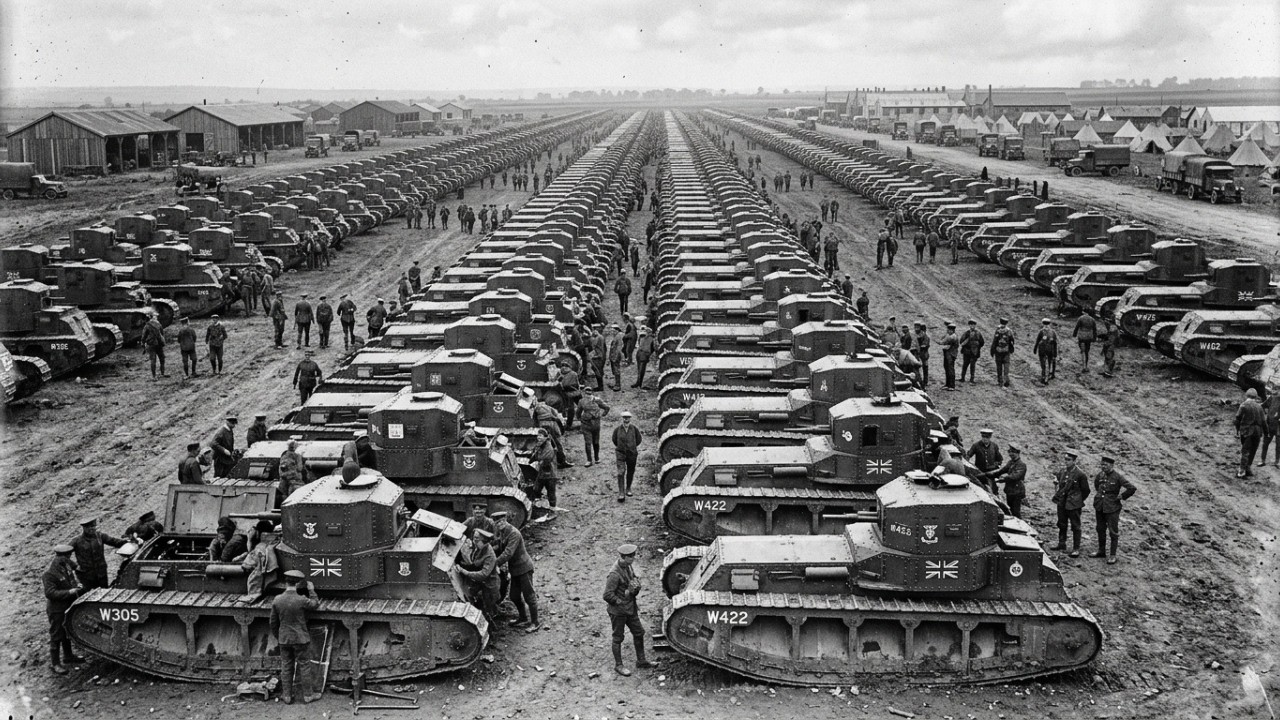
Meanwhile, other Whippets were simply withdrawn to depots at Bovington in Dorset and at Wool, where the Royal Tank Corps had established its principal training and experimental establishment. There, surviving machines were used for driver instruction, gunnery practice, and technical trials into the early 1920s, with a dwindling handful remaining formally on charge into the 1930s, even as they were manifestly obsolete beside newer designs such as the Vickers Medium.
Britain’s approach, in other words, prioritized wringing every remaining year of utility from existing stock rather than pursuing any ambitious new testing program, a marked contrast with what France and the United States chose to do with the small numbers of Whippets that passed through their hands.
If you’re finding this deep dive into post-war armored history interesting, consider subscribing. France’s interest in the Whippet was comparatively modest, reflecting the fact that French industry had already committed decisively to the Renault FT as its light tank of choice, a machine built in vastly greater numbers and considered by French commanders to be superior for infantry support roles.
Nonetheless, French technical missions inspected examples of the Whippet during joint Allied evaluations held at proving grounds near Champlieu and at the Renault trials facilities outside Paris, comparing its speed, armament arrangement, and mechanical reliability against their own designs. French assessments recorded through 1919 generally concluded that the Whippet’s twin engine steering system, in which the driver controlled two separate Tyler petrol engines to turn the vehicle, was mechanically ingenious but impractical for mass production and difficult for inexperienced crews to master. A judgment that reinforced France’s continued preference for the simpler single-engine Renault FT. The United States Army, still building its fledgling Tank Corps under officers including George Patton, likewise obtained at least one Whippet for evaluation, understood to have been examined at Aberdeen Proving Ground in Maryland, where American engineers cataloged its armor thickness of up to 14 mm, its top speed of roughly 13 km/h, and its unusual four-man crew arrangement of driver, commander, and machine gunners.
American interest, however, was similarly limited by the country’s own commitment to developing indigenous light tank designs derived from French practice, meaning the Whippet functioned there chiefly as a comparative reference rather than a template for imitation. The most consequential foreign deployment of the Whippet, by contrast, took place not through calm technical evaluation, but amid the chaos of the Russian Civil War.
Beginning in 1919, the British government, seeking to bolster the anti-Bolshevik White Russian forces without committing large numbers of its own troops, shipped surplus war equipment including Whippets to Southern Russia as part of the British military mission attached to General Anton Denikin’s Volunteer Army.
Six Whippets arrived with an initial consignment sent to Denikin, followed by a further 11 machines dispatched in July 1919, bringing the total sent to 17. They served alongside White Russian tank detachments, including units attached to General Pyotr Wrangel’s forces further south, with individual vehicles carrying names such as Sphinx, which fought with Wrangel’s First Tank Division in 1920.
The campaign proved disastrous for the Whites, and Bolshevik forces ultimately captured 12 of the 17 Whippets sent to Russia, either through battlefield defeat or mechanical breakdown and abandonment. The Red Army, in a detail that still amuses historians of the period, mistakenly believed the engine manufacturer’s name, Tyler, to be spelled Taylor, and consequently referred to their captured machines as Taylors.
At least one captured Whippet was substantially rearmed by Soviet forces, its forward machine gun replaced with a French 37-mm Puteaux cannon salvaged from other Allied stocks, and Soviet records indicate these captured tanks remained in service, chiefly for training purposes, until roughly the early 1930s, decades after their British designers had expected them to be retired.
A smaller, but historically significant transfer sent Whippets to Japan, whose army had no indigenous tank tradition of its own at the time. Somewhere between four and six Whippets were exported to Japan around 1919, becoming by most accounts the first tanks the Imperial Japanese Army ever operated. They were used initially for training purposes through the 1920s, with Japanese engineers modifying the vehicles to mount type three heavy machine guns, and improving armor protection around the driver’s position for better visibility. By the early 1930s, at least three of these aging machines had been deployed to the puppet state of Manchukuo in northeastern China, where they were used by Japanese units engaged in suppressing local resistance. An almost unimaginable final chapter for a design conceived to break the deadlock of the Western Front. This Japanese connection illustrates how a single British design, never intended for export in significant numbers, nonetheless contributed in a small way to the origins of armored doctrine in three entirely separate military traditions. By the mid to late 1920s, the systematic elimination of the
Whippet fleet was well underway. Driven less by any Inter-Allied Control Commission directive, since Versailles disarmament clauses applied to Germany rather than to Britain’s own equipment, than by simple economics and doctrine. Post-war budgets across the demobilizing British Army left little appetite for maintaining obsolete machinery.
And the Royal Tank Corps had already begun favoring newer, more capable designs. Whippets withdrawn from Irish service and from home depots were scrapped in substantial numbers through the 1920s. Their armor plate and mechanical components sold for scrap metal amid a broader post-war shortage that saw enormous quantities of surplus wartime equipment melted down across Britain and France alike.
Some machines were expended as targets on gunnery and anti-tank ranges, deliberately destroyed to test new weapons rather than preserved for their historical value. A fate shared by countless other pieces of Great War equipment considered simply outdated rather than significant. Of the roughly 200 Whippets originally built, the overwhelming majority, well over 90%, had been scrapped, destroyed in Russian fighting, or lost to attrition by the early 1930s, leaving only a scattered handful anywhere in the world. Today, only five confirmed Whippets survive, an extraordinarily small remnant of a production run that once numbered 200. Caesar the Second, serial number A259, is displayed at the Tank Museum in Bovington, Dorset, the very machine commanded by Lieutenant Cecil Sewell during the fighting near Bapaume in August 1918, for which he was posthumously awarded the Victoria Cross. Firefly, serial A347, still bears its original wartime paint and battle damage from a strike sustained on 17th of August 1918, and
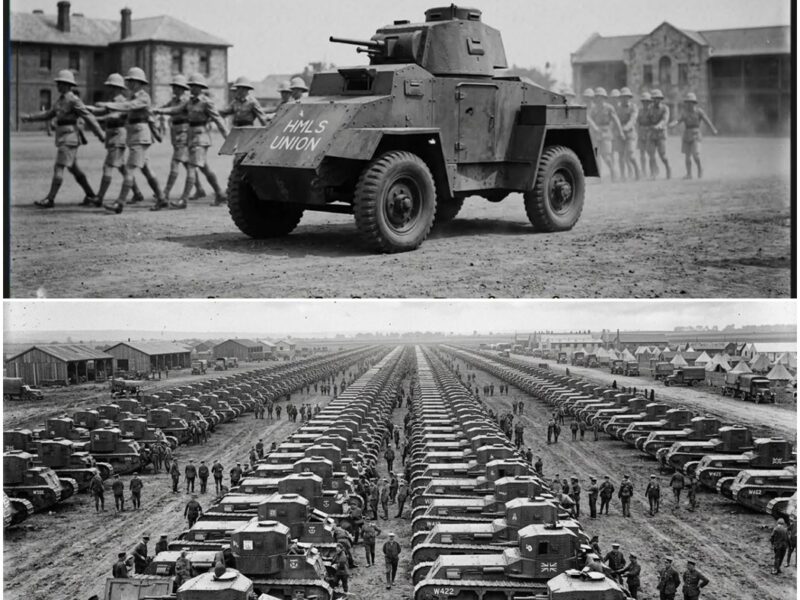
today resides at the Royal Museum of the Army in Brussels, having been presented to Belgium as a gift by British forces after the war. A Whippet identified as HMLS Union sits at the Army College in Pretoria, South Africa, whilst another, formerly named Carnaby, is preserved at Canadian Forces Base Borden in Ontario.
A fifth example, serial A284, was for many years held at Aberdeen Proving Ground in the United States before being placed into storage, its current public accessibility uncertain. None of the captured Russian examples are known to survive intact, though photographs and Soviet inventory records of the modified Sphinx, the cannon-armed Tiler variant, preserve something of their unusual second career.
The Whippet’s brief but consequential post-war existence offers a striking illustration of how quickly formidable wartime technology can be dispersed, repurposed, and largely forgotten. It fought in a British civil counterinsurgency in Ireland, in a foreign civil war on the Russian steppe under both white and red colors, and in Japanese imperial expansion in Manchuria, all within roughly 15 years of its design as a battlefield exploitation weapon for the Western Front.
Its twin-engine steering arrangement, whatever its practical shortcomings, fed directly into later British thinking about tank maneuverability, whilst its combat record at Amiens and Bapaume helped cement the doctrine that fast, lightly armored tanks had a distinct battlefield role separate from heavier infantry support machines, a principle that would echo, however imperfectly, in the cruiser tank concepts Britain pursued through the interwar years.
And what began as sheds full of quietly waiting machines at Erin in 1918 ended within a generation as scrap metal, museum pieces, and half-forgotten photographs from a Russian winter campaign most people have never heard of. If you found this video insightful, watch what happened to Britain’s heavy Mark V tanks after World War I next.
It explores how these lumbering giants of the Hindenburg Line were shipped to Russia, sold to Estonia and Poland, and scattered across proving grounds from Virginia to Kubinka. Like this video, subscribe, and hit the bell for more. Thanks for watching.