Why The ‘Condemned’ Churchill Out-Armoured The Tiger And Climbed Where No Tank Could D
June 1941, the Vauxhall Motors factory, Kimpton Road, Luton. Something enormous crawls out of the factory doors on steel tracks. Trailing exhaust smoke and the smell of fresh paint over raw metal, it is enormous, nearly 25-ft long and over 8-ft tall, wrapped in flat slabs of bolted steel.
Squatting on 22 tiny road wheels that give it the profile of a steel centipede, its turret carries a 2-pounder gun that most tank officers already consider obsolete. Its engine is two Bedford lorry motors bolted together. Producing 350 horsepower to drag nearly 40 tons of armor at a top speed that a man on a bicycle could match on a good road, it is slow, under-gunned, and so mechanically unreliable that 42% of all Churchills in service will be out of action by January 1942.
The manufacturer itself will insert a printed apology into the user handbook, admitting that things are not as they should be. It looked condemned. The German intelligence assessment after its first battle will call it easy to combat. Winston Churchill himself, the man whose name it carries, will tell Field Marshal Smuts that it was the tank they named after him when they found out it was no damn good.
And yet this condemned, apologized for, written-off machine would go on to fight on three continents, serve from the beaches of Dieppe to the hills of Korea, carry thicker frontal armor than a Tiger, climb mountain gradients that no other Allied tank could attempt, and spawn more specialist variants than any other British tank of the war.
Its formal designation was the Infantry Tank Mark IV, the A22. The world called it the Churchill, and it refused to die. To understand why the Churchill existed, you need to understand the panic Britain faced in the summer of 1940. The British Expeditionary Force had been driven from France. Nearly all of its armor had been abandoned on the beaches and fields around Dunkirk.
A German invasion was expected within weeks. The War Office needed a heavy infantry tank immediately, and it needed one that could be built by factories that had never produced a tank before. The original specification, the A20, had been designed by the Belfast shipbuilders Harland and Wolff. It was a throwback, a 43-ton monster intended for trench warfare, powered by a 300 horsepower Meadows engine that could barely move it.
Two prototypes were built, both were failures. The specification was dead. Dr. H. E. Merritt, director of tank design at the Woolwich Arsenal, handed the revised A22 contract to Vauxhall Motors in June 1940. Vauxhall was a car and commercial vehicle manufacturer. It had never built a tank. It was given 12 months to go from drawing board to production.
The design was complete by July. Prototypes ran by December. The first production tanks rolled out by June 1941. Vauxhall met the deadline almost to the day. The cost was reliability. The vehicle itself was an engineering contradiction. Its armor was its greatest asset and its engine was its greatest weakness.
The hull was constructed from flat unsloped plates of hardened steel bolted and riveted to a 12-mm mild steel inner frame. Frontal protection on the early marks reached 102 mm with 76 mm on the sides and 89 on the turret face. This made it one of the most heavily protected tanks in the world in 1941, but the 350 horsepower Bedford twin six, a flat 12 petrol engine created by joining two six-cylinder lorry engines side by side, was never powerful enough.
Maximum road speed was 15 mph and crews rarely pushed it beyond 10 because the noise at higher revolutions was unbearable. Cross-country speed dropped to 8 mph. Range was 90 miles. What saved the Churchill, what made it unlike any other tank in the war, was hidden underneath. 11 individually coil sprung road wheels ran along each side of the hull.
22 bogies carrying 44 wheels in total. The tracks wrapped over the top of armored side panniers, creating a ground contact length longer than any comparable Allied tank. Ground pressure sat at approximately 13 lb per square inch, lower than a Sherman under normal conditions. Only nine of the 11 wheels on each side bore weight.
The front pair engaged automatically when the tank nosed into an obstacle, acting as unditching wheels. The rear pair tensioned the track. The high-mounted drive sprocket meshed with the heavy track links like a rack and pinion system, pulling the tank upward with mechanical grip rather than relying on momentum. The result was a tank that could climb a gradient of 34°, cross a trench nearly 7 ft wide, and haul itself over a vertical step of 4 ft.
No other Allied tank could match those numbers. Most could not come close. Now, before we get into where this tank actually fought and what it proved on the battlefield, if you are enjoying this deep dive into British armored engineering, hit subscribe. It takes a second, costs nothing, and helps this channel keep producing these films.
The Churchill’s first taste of combat was a disaster, August 19, 1942. Dieppe. 29 Churchills of the 14th Canadian Army Tank Regiment, the Calgary Regiment, began the assault on the fortified French port. The churn and shingle beach destroyed them. Stones jammed the tracks and bogies.
Half the tanks could not leave the beach. Those that reached the esplanade were blocked by concrete anti-tank obstacles. Every single tank was lost. Not one could be recovered. The German assessment was dismissive. The Churchill, they concluded, was easy to combat. The program nearly died that day.
Senior figures in the War Office pushed to cancel the Churchill entirely and replace it with the Cromwell. What saved it was a small detachment of six Mark III Churchills sent to North Africa under Major Norris King, designated King Force. They fought at the Second Battle of El Alamein in October 1942. After two engagements, the six tanks had absorbed 106 hits from German anti-tank guns.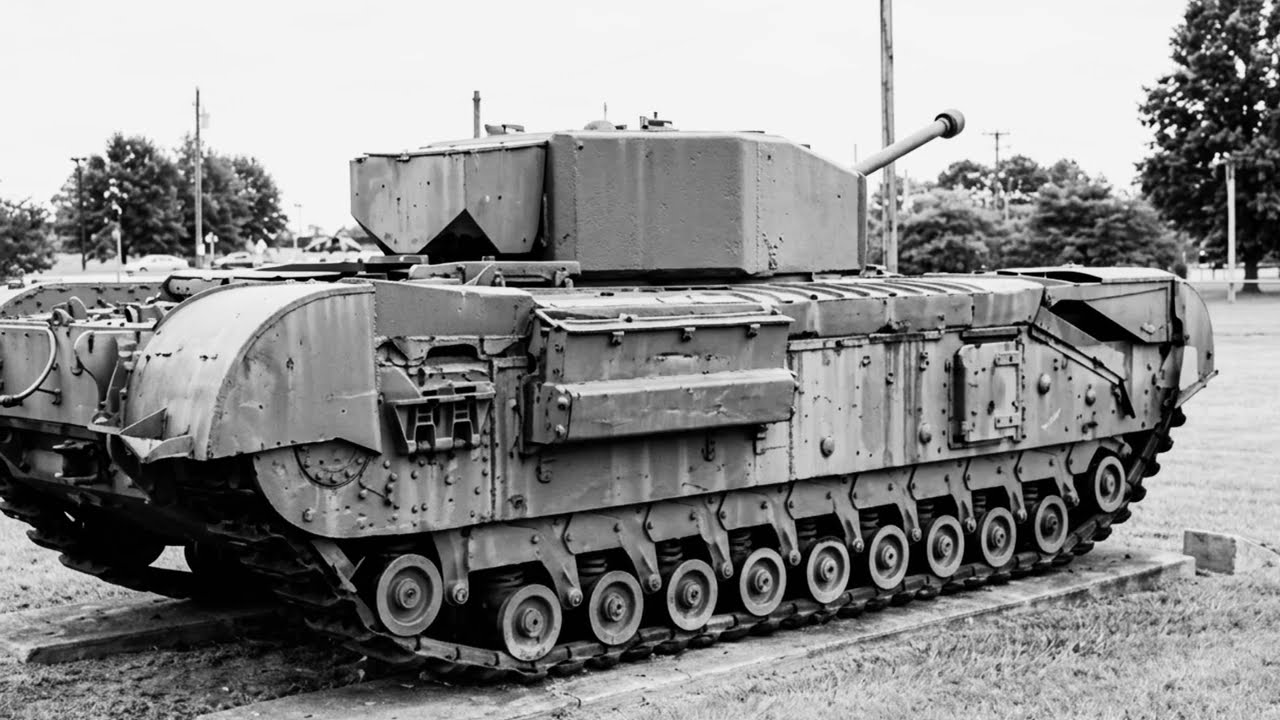
One Churchill was struck 30 times and suffered nothing worse than a broken track. Only one tank was destroyed. The armor held. The program survived. But the Churchill’s true redemption came in Tunisia with the British first army in early 1943 and it came not because of what the Churchill could survive but because of where it could go.
February 28th, 1943. Steamroller farm, Tunisia. A squadron, 51st Royal Tank Regiment, supporting the Coldstream Guards, attacked a position defended by 2,000 troops of the Hermann Göring division dug in behind 88-mm guns and anti-tank screens. Five Churchills were destroyed by Stuka dive bombers and direct fire before the attack even reached the farm.
Then Captain Ernest Hollonds, in the tank named Adventure, and Lieutenant J.G. Renton drove two surviving Churchills across an exposed causeway, took a glancing hit from an 88 at 20 yards, crushed the gun position, and then did something no one believed possible. They climbed a slope the Germans had assessed as impossible for armor.
The two tanks crested the ridge and fell on the German positions from above, destroying two Panzer IIIs, eight anti-tank guns, 25 vehicles, and inflicting an estimated 200 casualties. The Hermann Göring regimental commander’s intercepted radio transmission to his superiors explained his withdrawal by reporting that he had been attacked by a mad tank battalion which had scaled impossible heights.
Hollonds received the Distinguished Service Order. Renton received the Military Cross. Driver Trooper John Mitten received the Military Medal. Two months later, the Churchill delivered the performance that defined its entire legend. April 21, 1943. Longstop Hill, known to the locals as Djebel el Amera.
Churchills of the North Irish Horse, supporting the 78th Battleaxe Division, drove up gradients as steep as one in three, grinding up rocky slopes in low gear while German defenders on the summit watched in disbelief. A Churchill commanded by Sergeant O’Hare was the first to reach the top, breaching the German headquarters position and taking 50 prisoners.
Three more Churchills followed. A captured German officer, confronted with the tanks on the summit, said simply that he knew all was over the moment he saw them crest the ridge. German prisoners refused to believe tanks had climbed the hill until they were shown. They called the Churchills metal mules.
It was a maneuver, according to the regimental history, that only Churchill tanks could have achieved. In the same Tunisian campaign, a Churchill 6-pounder disabled the Tiger tank now preserved at the Bovington Tank Museum. Designated Tiger 131, it was the first intact Tiger captured by the Western Allies.
A solid shot struck the turret ring and jammed the traverse, wounding the crew and forcing them to abandon the vehicle. King George VI and Winston Churchill himself were both photographed with the captured Tiger in Tunis. The Churchill fought on through Italy, where the North Irish Horse again used its climbing ability in the Apennine Mountains approaching the Gothic Line.
It fought through Normandy, where the 6th Guards Tank Brigade captured Hill 309 during Operation Bluecoat in July 1944, exploiting terrain the Germans had assessed as impossible for armor, exactly as they had at Longstop Hill a year before. It fought through the Reichswald and the Siegfried Line.
Its specialist variants, the Crocodile flamethrower, the AVRE Assault Engineering Tank with its 290-mm Petard mortar, and the ARK Bridging Carrier, became the backbone of the 79th Armoured Division’s famous funnies. The Crocodile was so feared that captured crews were sometimes executed on the spot by German soldiers, and disabled crocodiles were destroyed rather than examined to prevent their secrets being studied.
On paper, the Tiger was the superior tank. Its 88-mm gun could destroy a Churchill at ranges the Churchill could never answer. It was faster, better armed, and carried the most feared anti-tank gun of the war. But the Churchill Mark VII, the final major production variant introduced in 1944, carried 152-mm of welded steel on its front hull and turret face. The Tiger carried 100-mm.
The Churchill’s frontal armor was over 50% thicker. Its side armor, at 95-mm, exceeded the Tiger’s 80 mm. The Tank Museum at Bovington states plainly that the Mark VII had considerably thicker armor than even the German Tiger. The Churchill could not kill a Tiger at range, but it could absorb punishment that would have destroyed almost any other Allied tank on the battlefield.
Approximately 5,600 Churchills were built across all gun tank marks, produced by a consortium of over a dozen manufacturers led by Vauxhall. Nearly 3,100 older models were reworked and upgraded during the war. The Churchill served in Korea with the 7th Royal Tank Regiment, where its hill climbing ability proved as valuable in 1951 as it had in Tunisia in 1943.
It was exported to the Soviet Union, to Australia, to Canada, to Ireland, where four Mark VIs served until 1969. It was replaced in British service by the Centurion, the universal tank that finally ended the separate infantry and cruiser tank lines. Churchills survive today at the Bovington Tank Museum, the Imperial War Museum, the Bayeux Memorial Museum, and in collections from Russia to Australia.
At least one Mark III at Bovington still runs. June 1941, Kimpton Road, Luton. Something enormous crawls out of the factory doors trailing exhaust and the smell of fresh paint. It is slow. It is under-gunned. Its engine is two lorry motors welded together. Its own manufacturer has apologized for it in writing.
The German assessment calls it easy to combat. The Prime Minister jokes that it was named after him because it was no damn good. It was underpowered. It was mechanically fragile in its early marks. It never carried a gun that could match the Panther or the Tiger at range. It arrived at Dieppe and lost every tank on the beach, and yet it climbed where no other tank could climb.
It absorbed 106 hits and kept fighting. It scaled gradients the enemy called impossible. It carried armor thicker than a Tiger. It fought from North Africa to Korea. It spawned more specialist variants than any British tank before or since. The Churchill was not fast. It was not elegant. It was not brilliantly engineered.
It was built in a panic by a car factory that had never made a tank, powered by an engine that was never strong enough, armed with guns that were always a generation behind, and none of that mattered because when it reached the hill that no other tank could climb, it climbed. That is not luck.
That is the difference between a specification and a war.