The ‘Crude’ Ford Pickup Ukraine Turned Into an MRAP to Fight Beside Britain’s Mastiff D
2014, the AutoKrAZ factory, Kremenchuk, central Ukraine. A vehicle rolls off the assembly line that looks like it has no business being on a battlefield. It is built on the chassis of a Ford F-550 pickup truck. Its armor is flat steel plate bolted and welded in sharp angles that make no concession to aesthetics.
It weighs under 9 tons. It carries eight men, two in the cab and six in the back, sealed inside a compartment that looks more like a reinforced shipping container than an armored personnel carrier. There is no V-shaped hull, no blast-deflecting monocle, no remote weapon station.
The whole thing cost roughly $250,000. It looked improvised. It looked desperate. It looked like something a country builds when it has no other choice. Within months, vehicles exactly like this one would be rolling east toward a war that was already consuming Ukraine’s Soviet-era armored fleet at a rate no one had predicted.
Within years, they would be operating alongside Western MRAP vehicles costing three, four, even five times as much, performing the same role, carrying the same soldiers, surviving the same threats over a thousand kilometers of front line against the second largest army in Europe, alongside Britain’s own Mastiff, a vehicle that had been tested, refined, and proven across two wars before Ukraine had even begun assembling its first armored car.
Its designation was the KrAZ Spartan, and it was the cheapest armored vehicle Ukraine ever sent to war. To understand why the Spartan existed, you need to understand the crisis Ukraine faced in the summer of 2014 when Russian-backed separatists seized government buildings across the Donbas, and Russian special forces crossed the border unmarked, the Ukrainian military discovered that decades of post-Soviet neglect had hollowed out its vehicle fleet.
The armored personnel carriers it had inherited, the BTR-60s, the BTR-70s, the BTR-80s, were aging, poorly maintained, and being destroyed faster than they could be repaired. Engines seized, transmissions failed. Vehicles that had sat in open storage since the 1990s were pressed back into service with rusted hulls and degraded optics.
Ukraine needed protected transport immediately, not in 2 years, not after a competitive procurement process. Now, the country had its own armored vehicle programs. The Dozor-B and the Kozak were both under development as indigenous designs, but development is not production, and production is not delivery.
Ukraine needed something that could be assembled from available components and driven to the front within weeks. The answer came from a truck factory on the banks of the Dnieper. The Kremenchuk Automobile Plant, known as AutoKrAZ, had been building heavy trucks since 1959. The factory’s origins went back further to 1945 when the Soviet People’s Commissariat for Transportation Routes issued a warrant to construct a mechanical bridge plant in Kremenchuk.
For its first decade, the facility built prefabricated bridges, roughly 600 of them, spanning the Dnieper, the Volga, the Dniester, and the Daugava. In the late 1950s, the plant was converted to truck production, and by the 1960s it had become the Soviet Union’s primary manufacturer of heavy-duty off-road vehicles.
The KrAZ-255, a six-wheeled military truck so rugged and so simple that it earned the nickname Lapot, meaning bast shoe, was exported to more than 40 countries. It hauled ammunition for the Soviet Army, carried rocket launchers for allies across Africa and Asia, and remained in production for over three decades.
But AutoKrAZ had never built a proper armored fighting vehicle. It had no indigenous design capability for protected platforms, no testing infrastructure, no decades of MRAP development behind it. What it did have was a licensing agreement with the Streit Group, a Canadian-based armored vehicle manufacturer headquartered in the United Arab Emirates.
Streit had designed the Spartan as a light armored personnel carrier for export to security forces and police units in the Middle East and Africa. It was a commercial product built on a commercially available chassis, and that was precisely its advantage. The Spartan was constructed on a Ford F-550 Super Duty pickup platform powered by a Ford 6.
7 L Scorpion V8 turbocharged diesel engine producing 400 horsepower at 2,800 revolutions per minute mated to a six-speed automatic transmission driving all four wheels. The chassis was off-the-shelf, the drivetrain was off-the-shelf. The engine was a civilian unit you could service at a Ford dealership anywhere in the world.
Every major mechanical component had a global supply chain behind it. Spare parts inventories in dozens of countries and trained technicians who had never seen the inside of a military depot. The armor was not off-the-shelf, but it was not exotic either. Flat steel plate rated to CEN level BR6 meaning it could stop multiple hits from 7.
62 mm NATO ball ammunition from any angle. The hull floor offered limited blast protection sufficient to withstand two DM51 high explosive fragmentation hand grenades detonated beneath the vehicle. That was the specification. It was not designed for buried anti-tank mines. It was not designed for explosively formed penetrators.
It was designed to keep small arms fire from killing the people inside. The vehicle measured 6 m long, 2.44 m wide, and 2.4 m high. Gross weight was 8,800 kg. It rode on run-flat tires. Maximum speed on paved roads was 110 km/h. Maximum range on a single tank of 257 L of diesel was 800 km. It could ford water 1.2 m deep, climb a 60% gradient, and handle a 35% side slope.
The crew compartment seated two in the cab and six in the rear with a protected turret ring on the roof capable of mounting a 12.7 mm heavy machine gun or a 40 mm automatic grenade launcher. None of this was revolutionary. None of it was sophisticated. What it was was available. In August 2014, the Ukrainian Ministry of Interior ordered 21 Spartans for the National Guard.
They were assembled at the Kremenchuk plant from imported components, with only around 20% Ukrainian content by value, according to AutoKrAZ’s General Director Roman Chernyak. After the military parade marking Ukraine’s 23rd Independence Day on August 24, those vehicles were loaded onto transporters and sent directly to the conflict zone in eastern Ukraine, from factory to frontline in weeks.
Now, before we get into where the Spartan actually fought and how it measured against some of the most expensive protected vehicles in the world, if you are enjoying this deep dive into wartime engineering under pressure, hit subscribe. It takes a second, costs nothing, and helps the channel grow.
The Spartan entered combat in the Donbas with units of the National Guard operating in and around Mariupol, Sloviansk, and the contact line that was hardening across Donetsk and Luhansk oblasts. The vehicles were allocated to units of the National Guard, including elements associated with the Azov Regiment, the 3rd Operational Brigade nicknamed the Spartans, and territorial defense battalions that had been stood up from civilian volunteers only months earlier.
Their role was straightforward: move soldiers from staging areas to forward positions, evacuate wounded under fire, deliver ammunition and supplies to units operating in urban terrain, where unarmored trucks were being shredded by sniper fire and shrapnel. The vehicle was not designed for this.
The Streit Group had marketed the Spartan to police forces and private security contractors in the Gulf States. It was meant for checkpoint duty, VIP escort, and low-intensity patrol work in permissive environments. Ukraine was using it in a conventional ground war against artillery, mortars, mines, and automatic weapons.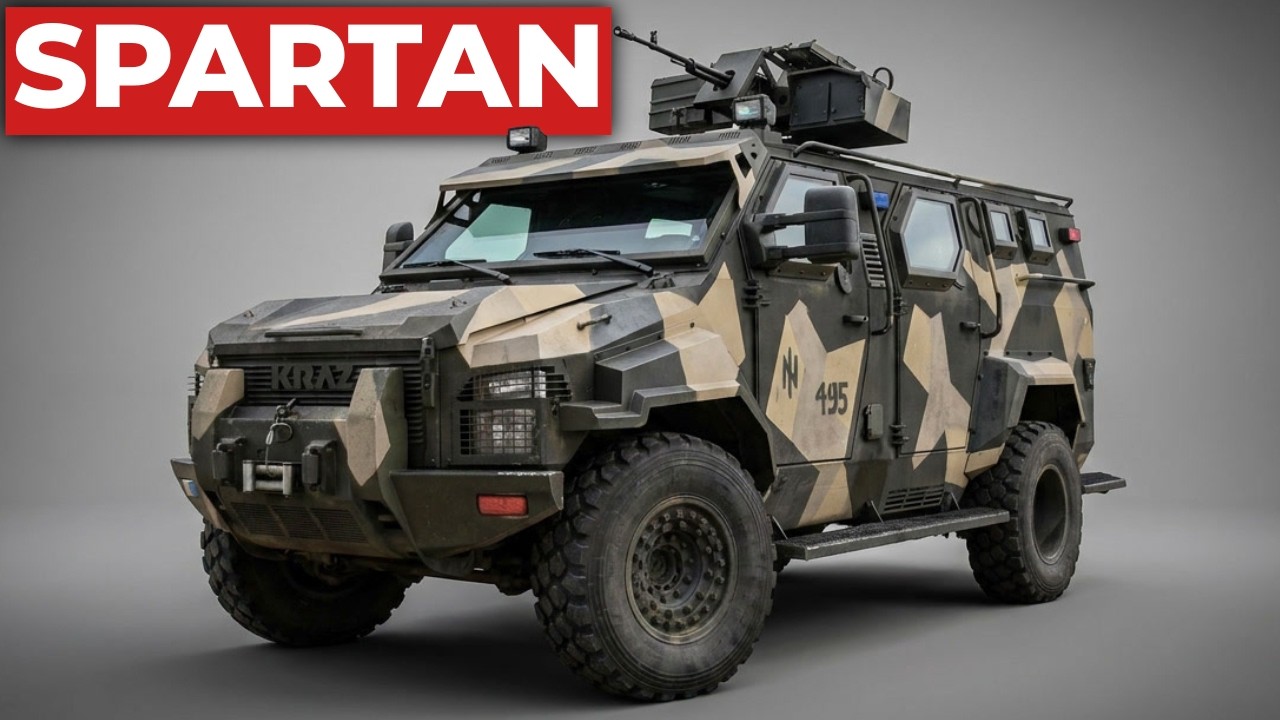
The gap between intended use and actual deployment was enormous, and yet the Spartan kept running. Soldiers from the Donbas Ukraine special forces battalion, who visited the Kremenchuk plant to collect spare parts in person, because the official supply chain could not keep up, reported that the KrAZ vehicles were fast, powerful, and capable of driving over fields and broken roads in conditions that destroyed their aging Soviet trucks.
One soldier described the difference bluntly, “The old ZIL and KamAZ trucks broke constantly. They could only carry loads on even roads over short distances. The KrAZ vehicles ran in rain, in snow, on rough terrain without failing.” Commanders requested more. The National Guard received additional batches.
The State Border Guard Service of Ukraine took delivery of 47 of the related KrAZ Cougar variant built on a Toyota Land Cruiser 79 chassis. In November 2014, the Ukrainian government placed an order for 1,200 vehicles and 200 armored personnel carriers from AutoKrAZ, a contract worth 1 billion hryvnia. AutoKrAZ also donated Spartan and Shrek armored vehicles with a combined value of roughly $1 million directly to the Armed Forces free of charge.
The Come Back Alive Foundation, one of Ukraine’s largest civilian defense charities, later purchased a Spartan for a mechanized brigade fighting in the Kharkiv region. The vehicle cost 10.2 million hryvnia, roughly $250,000. $250,000. To put that number in perspective, consider the vehicle the Spartan would eventually share a battlefield with, Britain’s Mastiff Protected Patrol Vehicle.
The 6×6 MRAP that the British Army deployed to Basra, Iraq in December 2006 cost approximately $644,000 per unit in its base Cougar 6×6 configuration. But the Mastiff was not a base Cougar. It was a Cougar that had undergone more than 50 modifications to meet British Army requirements. NP Aerospace handled the integration work in the United Kingdom, fitting additional side armor, slat armor to defeat rocket-propelled grenades, electronic countermeasures, Bowman secure radios, and the Enforcer Remote Weapon Station. Foster Miller supplied ballistic armor packages under a $10 million subcontract. Individual contracts ran into tens of millions. The total Mastiff and Vector procurement program was expected to cost approximately 120 million pounds. Around 450 Mastiffs were produced across three principal variants with further sub-variants tailored for the Royal Engineers, the RAF Regiment, and Explosive Ordnance Disposal Teams. The Mastiff was, by any measure, a superb
vehicle. It weighed approximately 23 tons fully loaded, rode on six wheels with a Caterpillar C7 diesel producing 330 horsepower, carried two crew and eight soldiers, and offered STANAG level three ballistic protection with exceptional mine blast resistance from its V-shaped hull.
That hull could deflect improvised explosive device blasts that would have destroyed a conventional armored personnel carrier. The British Army’s own Soldier magazine made a statement that became legendary within the force protection community. There had not been a single fatality in a Mastiff due to enemy action in theater.
That record was extraordinary. The Cougar family, on which the Mastiff was based, had withstood thousands of IED and landmine attacks across Iraq and Afghanistan. Pentagon data presented to the United States Congress in 2007 showed that the early MRAP vehicles were up to 400% more effective than up-armored Humvees in reducing injuries and deaths.
The Mastiff’s record was eventually broken. In 2009, a large IED attack in Afghanistan became the first to cause fatalities inside a Mastiff. Military analysts noted that the device was extraordinarily powerful, likely large enough to physically lift and overturn the vehicle.
But one breach, after years of sustained combat, did not diminish the Mastiff’s reputation. It confirmed that defeating the vehicle required an exceptional effort. The Spartan could not match any of this. Its flat-bottomed hull offered nothing close to the Mastiff’s blast deflection geometry. Against buried anti-tank mines or the sophisticated explosively formed penetrators that defined the Afghan and Iraqi battlefields, the Spartan would not have survived where the Mastiff did.
Its armor ceiling was lower. It had no electronic countermeasures in its base configuration, no integrated battle management system, no remote weapon station as standard. It could not absorb the punishment that the Mastiff was specifically engineered to endure, but the Spartan was not trying to be the Mastiff.
It was trying to exist when nothing else could. The economics told the story. For the cost of a single Mastiff, Ukraine could field two or three Spartans. For the cost of the entire Mastiff procurement program, Ukraine could have equipped entire brigades. And unlike the Mastiff, which required specialist maintenance, proprietary parts, and trained NP Aerospace technicians, the Spartan could be repaired by any mechanic who had worked on a Ford truck.
In a war of attrition, where vehicles were being destroyed daily and replacement speed determined whether units could continue fighting, that difference was not theoretical, it was operational. When Russia launched its full-scale invasion on February 24, 2022, that distinction became existential. Ukraine lost armored vehicles at a rate not seen in European warfare since 1945.
Hundreds of BTR and BMP variants were destroyed, captured, or abandoned in the first weeks. Entire motor pools were overrun before vehicles could be started. The need for any platform that could move soldiers under protection became desperate. AutoKrAZ, still operating in Kremenchuk despite the city sitting within range of Russian cruise missiles, continued to supply vehicles from existing stock.
In June 2022, Russian strikes hit Kremenchuk directly, destroying a shopping center and killing civilians. The factory continued to operate. In November 2022, President Volodymyr Zelenskyy nationalized AutoKrAZ under martial law, seizing the assets of the factory’s parent company, the Finance and Credit Group, to prioritize defense production.
The Kremenchuk Automobile Plant, which had begun life in 1945 building bridges for a shattered Soviet Union, was now formally a wartime enterprise for the second time in its history. Meanwhile, Britain began transferring its own Mastiff fleet to Ukraine. In April 2022, the United Kingdom delivered Mastiff MRAP vehicles and Jackal mobility platforms as part of a broader military aid package that included Stormer air defense vehicles, CVR(T) reconnaissance variants, and thousands of NLAW antitank missiles. Reports indicated that approximately 80 Mastiff, Husky, and Wolfhound MRAP vehicles were included in the initial transfer alongside 40 combat reconnaissance vehicles. By 2025, 39 additional Mastiffs and one Ridgeback had been transferred to Ukraine. The British Army was disposing of its legacy MRAP fleet as newer platforms entered service, and the vehicles that had saved British lives in Helmand were now saving Ukrainian lives in Donetsk. The Spartan and the Mastiff were
operating in the same theater, on the same front lines, against the same enemy. One had been designed by a NATO defense contractor, tested by the British Army across two wars, and refined through 50 modifications to meet the most demanding force protection standards in the Western alliance. The other had been assembled in a Ukrainian truck factory from a Canadian design on an American pickup chassis, with 80% of its components imported, and rushed to war within weeks of its first order.
Both carried soldiers, both stopped rifle rounds, both brought crews home. Ukraine was not fighting in Afghanistan. Ukraine was fighting a war of attrition across a front stretching more than a thousand kilometers, where the primary threats to transport vehicles were artillery fragments, small arms fire, FPV drones, and the sheer daily volume of losses that demanded replaceable, repairable, affordable machines.
In that calculus, a vehicle that cost a quarter of a million dollars and could be rebuilt with Ford truck parts was not a compromise. It was a strategy. By 2016, AutoKrAZ had pushed the Spartan concept further than anyone expected. The company partnered with Ukrainian technology firm Infocom to develop an autonomous variant, the first unmanned ground vehicle produced in Ukraine.
The pilot drive system integrated an infrared camera with automatic target designation, a 360° video camera, front and rear radar for obstacle detection, a distance measuring device, and a capacitive sensor with a detection range of 18 m. The system could measure road width, detect obstacles, and execute avoidance maneuvers without human input.
The unmanned Spartan could be controlled by tablet, smart glove, or dedicated operator control station at ranges of 10 to 50 km via Wi-Fi or WiMAX wireless networks. It offered three driving modes. Smart Drive followed a predetermined GPS path. Teach and Drive stored route coordinates from a manually driven run.
Return home brought the vehicle back automatically if communications were lost. The autonomous Spartan was designed to deliver ammunition, fuel, food, and medical supplies to frontline positions, and to evacuate wounded soldiers without risking a single crew member. It was unveiled at the Arms and Security Exhibition in Kyiv in October 2016, and displayed again at the AutoKrAZ test site in December 2019.
Alongside the company’s heavier platforms, the KrAZ Shrek, the KrAZ Fiona, and the KrAZ Hulk, it was basic by Western standards. It was functional by Ukrainian standards, and it anticipated by several years the explosion of unmanned ground logistics platforms that would come to define the later stages of the Russo-Ukrainian War, where drone-saturated battlefields made manned resupply runs increasingly suicidal.
2014, the AutoKrAZ factory, Kremenchuk, central Ukraine. A vehicle rolls off the assembly line built from a Ford pickup chassis, flat steel plate, and a licensing agreement with a Canadian company most defense analysts had never heard of. It has no V-shaped hull, no blast-resistant monocoque, no billion-dollar development program behind it, no 50 modifications approved by a Ministry of Defense Procurement Board, no Soldier a article celebrating its invincibility.
It has a water fight and a price tag a besieged nation can afford. The KrAZ Spartan was not elegant. It was not optimized. It was not the vehicle Ukraine wanted. It was the vehicle Ukraine needed at the moment Ukraine needed it at a cost Ukraine could bear. It fought alongside Mastiffs that cost five times more and MaxxPro’s that weighed twice as much and it did the one thing that mattered.
It moved soldiers forward and brought them back alive. Britain built the Mastiff to protect every life inside it against the worst threat the enemy could bury in the road. Ukraine built the Spartan to put any protection at all between its soldiers and the bullets that were killing them in unarmed trucks.
Both philosophies saved lives. Both were right for their moment. That is not a contest between good engineering and bad engineering. That is the difference between a nation that can afford perfection and a nation that cannot afford to wait for it.