The ‘Impossible’ British Glider That Dropped Tanks Behind Enemy Lines At Night D
June 6, 1944. RAF Tarrant Rushton, Dorset. 30 Halifax bombers taxied into position on the main runway, each one towing something that made ground crews stop and stare. Behind every bomber sat a wooden aircraft with a wingspan of 110 ft, a fuselage the size of a railway carriage, and a 17,000 lb tank bolted to its floor.
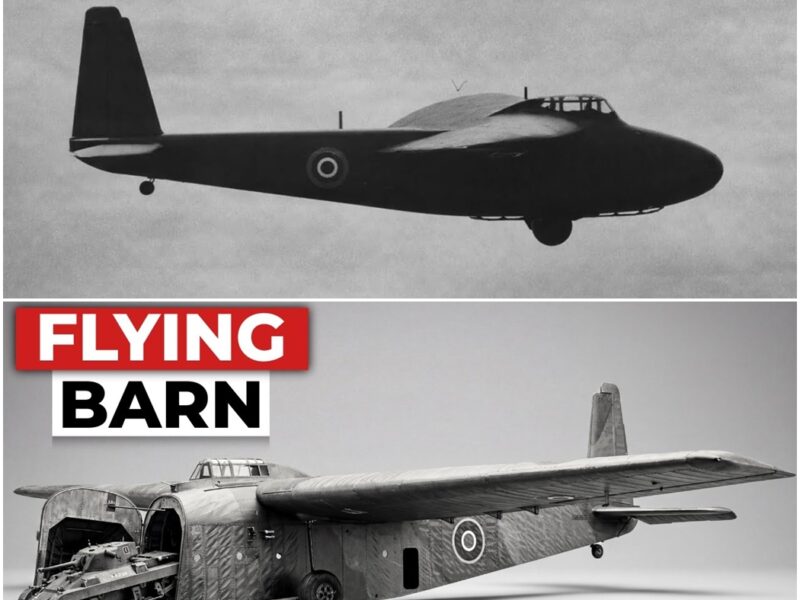
Nobody on the German side believed this was possible. The British were about to fly tanks across the English Channel, release them over occupied France, and land them in fields behind enemy lines. No nation had ever done it. No other nation could. The General Aircraft GAL 49 Hamilcar was the largest glider the Allies ever built, and the only aircraft in the world designed to swallow a tank hole and spit it out ready to fight.
The problem was simple and brutal. British airborne forces dropped by parachute were light infantry. They carried rifles, grenades, and a few mortars. The moment German armor rolled toward their positions, they had nothing that could stop it. At Bruneval in 1942, paratroopers had pulled off a brilliant raid, but depended entirely on the Royal Navy arriving to extract them before enemy reinforcements closed in.
For the planned invasion of Europe, airborne troops would need to hold ground for hours, possibly days, against Panzer counterattack. Without armor or heavy anti-tank guns, they would be overrun. The problem had been visible for years. Existing gliders offered no solution. The Airspeed Horsa, the standard British troop glider, carried 25 soldiers or a jeep.
The American Waco CG-4A managed even less, with a maximum payload of just 3,710 lb. Neither could carry anything heavier than a light artillery piece. A Tetrarch light tank weighed 17,000 lb. Even the 6-pounder anti-tank gun, the best infantry anti-armor weapon available in 1942, could not reliably penetrate the frontal armor of a Tiger at typical combat ranges.
Airborne troops needed tanks of their own. They needed anti-tank guns heavy enough to kill Panthers, and they needed those weapons delivered silently at night into fields surrounded by the enemy. The gap between what airborne forces needed and what any aircraft could deliver seemed impossible to close.
The Air Ministry issued specification X.27/40 in late 1940 calling for a glider capable of carrying a tank. General Aircraft Limited in Hanworth accepted the challenge. The chief designer, F. F. Crocombe, started not with aerodynamics but with a single question. How do you fit a Tetrarch inside a fuselage and get it out again in seconds under fire? The answer was an aircraft built around a hole.
Crocombe designed a high-wing monoplane constructed almost entirely from birch and spruce, skinned in fabric-covered plywood with steel reinforcements at load-bearing points. The cockpit sat on top of the fuselage 15 ft above the ground because the entire lower body was a cargo bay. That bay measured 32 ft long, 7 ft 10 in wide, and 7 ft 7 in tall.
A Tetrarch was 7 ft 7 in across. It fit with 3 in to spare on each side. The most ingenious feature was the nose. The entire forward section hinged on the starboard side and swung open like a door. To load the aircraft, ground crews deflated the undercarriage shock absorbers, lowering the fuselage to ground level, and the tank simply drove in.
Tank crews stayed inside their vehicles for the entire flight strapped into special harnesses with a flexible exhaust tube venting engine fumes through a port in the fuselage wall. After landing, the pilot deflated the undercarriage struts again. The tank driver released the cargo lashings and drove forward, and the tank’s own weight activated a pressure plate on the cargo bay floor.
That plate operated a cable and lever system designed to automatically swing the nose open. The tank rolled straight into combat. No ramps, no assembly, no delay. According to General Aircraft Limited trial reports from 1942, the entire unloading sequence took under 60 seconds. A half-scale prototype, the GAL 50, flew in September 1941.
The full-scale prototype lifted off from RAF Snaith in Yorkshire on March 27, 1942, towed by a Halifax bomber. Production was contracted to a group of woodworking firms, the Birmingham Railway Carriage and Wagon Company, the Cooperative Wholesale Society, and AC Cars, all coordinated by furniture manufacturer Harris Lebus of Tottenham.
The Ministry of Aircraft Production had promised 18,000 glider cars between March and August 1942. By September, exactly one had been delivered. Managers were replaced, schedules were rewritten. The Americans ordered 140 Hamilcars for carrying bulldozers in the Pacific, then canceled when production crawled. By D-Day, only about 80 existed.
The final total reached 344 completed aircraft. The aircraft specifications reflected its singular purpose. Empty weight was 18,400 lbs. Maximum loaded weight hit 36,000 lbs, giving a maximum payload of 17,600 lbs. Towing speed behind a Halifax was 150 mph. Stalling speed with flaps down was just 52 mph.
A small compressed air bottle operated the flaps, and it held enough pressure for exactly one deployment. There would be no second approach. Only four-engine bombers had the power to tow a loaded Hamilcar. The Handley Page Halifax was the primary tug, with the tow rope measuring 4.2 in circumference and 350 ft long.
Internal telephone wires ran through the rope for voice communication between cockpits. The glider flew in high tow position, slightly above the tug. Dropping into the bomber’s slipstream was the chief fear of every Hamilcar pilot, as the resulting oscillation could snap the rope and send 36,000 lbs of glider into an uncontrolled dive.
For night flying, a cable angle indicator, nicknamed the angle of dangle, displayed two illuminated white lines on a dial connected to the tow cable, allowing pilots to hold position without visual reference. Every Hamilcar landing was a one-shot commitment of wood, steel, and armored vehicle onto whatever patch of contested ground lay ahead.
Now, before we get into the combat record, a quick moment. If you are finding this interesting, a like on this video genuinely helps more than you might think. The algorithm notices. Now, back to the Hamilcar. On the evening of June 6th, 1944, 30 Hamilcars lifted off from Tarrant Rushton as part of Operation Mallard.
Four more had already landed in the pre-dawn darkness of Operation Tonga. The evening wave carried 20 Tetrarch light tanks of the 6th Airborne Armoured Reconnaissance Regiment to landing zone N, north of Ranville. This was the first time in history that tanks were delivered by air directly into combat, intact and ready to fight. Losses were sobering.
One Tetrarch broke free of its shackles mid-flight over the Channel, crashed through the Hamilcar’s nose, and both plunged into the sea. The pilot, Staff Sergeant Robinson, aged 28, is buried at Ranville. Two Hamilcars collided on the landing zone. 11 vehicles were temporarily immobilized when parachute rigging tangled in their tracks.
Yet, the operation succeeded. Major General Richard Gale wrote that it was impossible to express the relief he felt watching these reinforcements arrive. The 211th battery was engaging German targets within 30 minutes of landing. According to the D-Day Overlord assessment, the Hamilcar reinforcements deprived the 21st German Armoured Division of any hope of a successful counterattack before dark.
Market Garden in September 1944 told a different story. Approximately 38 Hamilcars were planned across three lifts to support the 1st Airborne Division at Arnhem, carrying 17-pounder anti-tank guns, Universal Carriers, and stores. No tanks. The landing zones near Wolfheze sat on soft soil, and several Hamilcars dug furrows into the earth on touchdown and flipped completely over.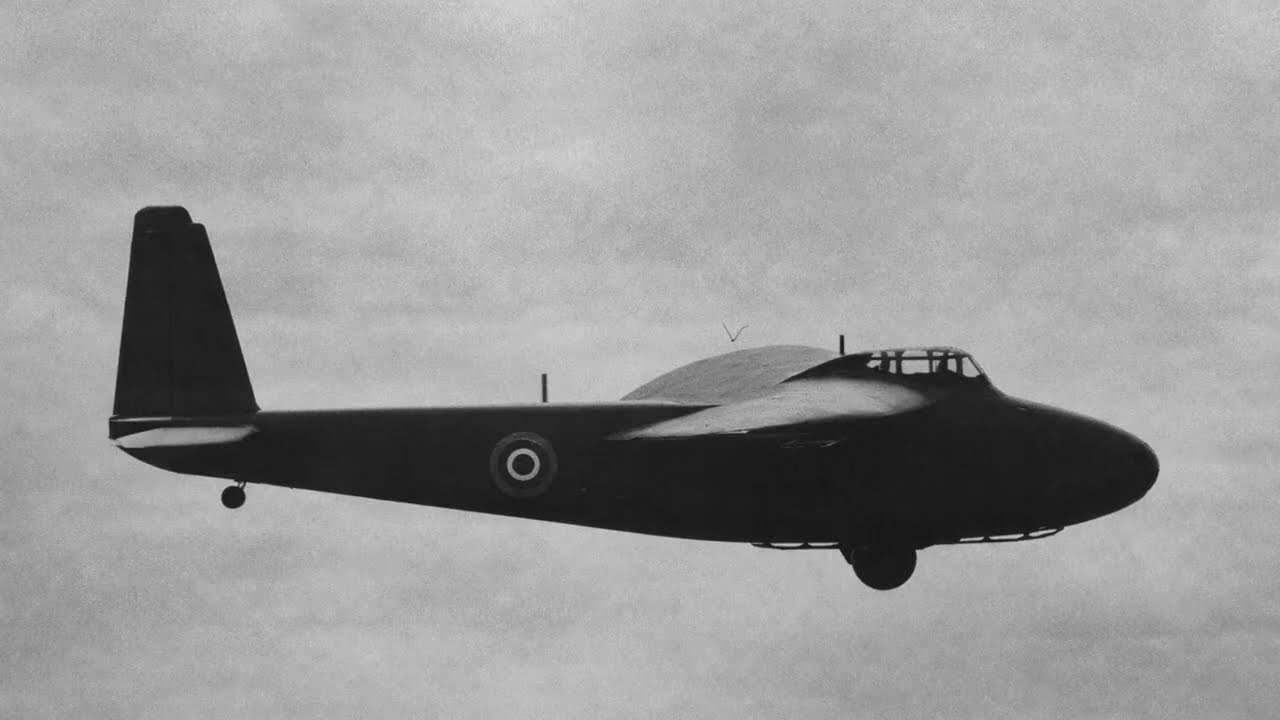
With the cockpit mounted on top of the fuselage, this proved fatal. Three pilots were killed. The operation itself failed at Arnhem. Of 10,000 men who landed with the first airborne division, only 3,000 came out. Operation Varsity on March 24, 1945 brought the worst single day the Hamilcar ever faced.
Montgomery ordered a daylight assault across the Rhine, the largest single day airborne operation in history. 48 Hamilcars carried 17-pounder guns, Universal Carriers, and M22 Locust light tanks, the only combat deployment of the Locust in the entire war. German anti-aircraft fire was intense. Staff Sergeant Desmond Page of the 2nd Ox and Bucks described the approach by saying the flak was murderous, and the leading glider was blown to pieces almost immediately.
Germans had learned from Normandy and Arnhem that even tracer rounds could ignite the wooden fabric-covered construction. Pilots were found burned to death in their cockpits. Of the eight Locusts, one was shot down when flak tore off a wing, flipping the tank upside down on impact, though the crew crawled out alive.
Another crashed through a farmhouse, remaining mobile but with its guns and radio destroyed. One was brewed up by an 88-mm gun while supporting Americans clearing a farm. Only four reached their rendezvous point. The regimental commanding officer, Lieutenant Colonel Stewart, rallied his scattered crews wearing a brightly colored cavalry forage cap and sounding his hunting horn.
Glider pilot regiment casualties exceeded 20% killed or wounded out of 890 personnel. 60% of those killed were RAF pilots drafted in to replace Arnhem losses and given hasty conversion training. Yet, Varsity achieved all its tactical objectives. Eisenhower called it the most successful airborne operation carried out to date.
Perhaps the most remarkable Varsity account describes a Bren Carrier deployment. A Hamilcar came diving toward a ground position, crashed through a large wooden farm building, and before the roof tiles stopped falling, an engine roared to life and a Bren carrier drove out as if nothing had happened.
The two glider pilots emerged unharmed and disappeared with the carrier toward their objective. The Hamilcar’s competitors never matched its balance of ambition and practicality. The German Messerschmitt Me 321 Gigant had a 180-ft wingspan and could theoretically carry a Panzer IV medium tank, something far beyond the Hamilcar’s capacity.
But towing it required three Bf 110 fighters in a V formation so dangerous that a single 1941 accident during a rocket-assisted takeoff killed all 129 occupants in a midair collision. The Heinkel He 111 Zwilling two bomber fuselages fused together with a fifth engine offered a safer towing solution but remained complex and rare.
The Germans eventually abandoned the glider entirely and converted it into the powered Me 323, which proved devastatingly vulnerable to Allied fighters. The American Waco CG-13, designed as a heavy glider, achieved a payload of 10,200 lb, still far short of a tank’s weight, and saw combat exactly once, a single glider in the Philippines in June 1945.
Only Britain built a glider that a single four-engine bomber could tow, that carried a tank, and that delivered it ready to fight in under a minute. The men who flew the Hamilcar served in the Glider Pilot Regiment, a unit that earned among the highest casualty rates of any British regiment in the war.
Bill Gladden of the 6th Airborne Armoured Reconnaissance Regiment, who died in April 2024 aged 100, claimed to be the first man to fly with a tank in a glider. During his D-Day flight, he climbed on top of the Tetrarch to look out a fuselage window just as the Halifax released the tow rope. He was told anyone not in their seat at that moment had to freeze in place to avoid upsetting the glider’s balance.
He landed in Normandy lying flat on top of a tank. Stanley Maxted, a Canadian BBC war correspondent, flew in a Hamilcar during Varsity. His recording, preserved at the Imperial War Museum, captures intercom dialogue between tug and glider pilots in the moments before release.
After his glider crash-landed under fire, Maxted described an explosion that seemed to be inside his head, the smell of burnt cordite, and something hot and sticky dripping over his right eye. He survived and published his account in Maclean’s magazine. C Squadron of the Glider Pilot Regiment, the specialist Hamilcar unit commanded by Major Jim Dale, completed over 2,800 training lifts with an average of 50 per crew.
Only seven pilots were killed in training. The regiment as a whole was not so fortunate. By December 1945, 64 Hamilcars remained at Tarrant Rushton. Wooden construction that had saved strategic metals during the war became a liability in peace. Glue deterioration attacked the laminated structures. Plywood delaminated. Fabric split.
The aircraft that had survived flak and crash landings could not survive English weather and neglect. 44 were moved to breaking up facilities in January 1946. By February 1947, only 12 remained operational. By the early 1950s, all were scrapped. A powered variant, the GAL 58 Hamilcar Mark X, fitted with two Bristol Mercury engines producing 965 horsepower each, could take off under its own power and fly home empty for reuse.
It was designed to solve the tropical towing problem for the planned invasion of Japan. 20 were completed with 100 on order when Japan surrendered in August 1945. One example flew with the Transport Command Development Unit at RAF Brize Norton until June 1947. None saw combat. No complete Hamilcar survives today.
A fuselage section of TK777 sits at the Museum of Army Flying at Middle Wallop. A section of TK718 rests at the Bovington Tank Museum alongside a Tetrarch. Recovered in 1990 from a Wiltshire farm where it had spent decades as a shed. June 6th, 1944, a wooden aircraft the size of a railway carriage touched down in a Norman field.
The undercarriage compressed. The nose swung open. A Tetrarch tank drove out and opened fire within minutes. No other nation solved the problem of putting armor behind enemy lines from the air. The Hamilcar was too few, too fragile, and too expensive, but it did something no other machine in the world could do.
And the men who flew it paid a price no other regiment matched.