Why This ‘Ugly’ British Recovery Truck Dragged Knocked-Out Tanks Off The Battlefield D
1937, a factory floor in Watford, Hertfordshire, England. A vehicle rolls out of the assembly shed at Scammell Lorries Limited on Tolpits Lane. It is enormous. It sits high off the ground on six thick rubber tires. The rear four arranged in two pairs on a bogie that pivots and flexes independently of the chassis.
The cab is wide and square-shouldered. A heavy winch drum is bolted behind the cab. The whole machine weighs more than eight long tons before it carries a single kilogram of load. It looked wrong. It looked like something built for an oil field, not a battlefield. It was not fast. Its top speed was 24 mph on a smooth road.
It had no armor. It had no weapons. It was just a truck. And yet this machine would haul the heaviest guns of the British Royal Artillery across three continents. It would drag stricken tanks off battlefields in the Western Desert, in the hills of Italy, and through the ruins of Northwest Europe. It would serve in three distinct roles, be built in nearly 3,400 examples, outlast the armies it helped to save, and remain in British military service for nearly five decades.
The last one was withdrawn from service in Belize in the 1980s, and it was not scrapped. It was shipped home and restored. A machine that pulled everything else was considered too important to let go. Its designation was the Scammell Pioneer, and it was the most capable heavy tractor Britain built during the Second World War.
To understand why the Pioneer existed, you need to understand the problem the British Army faced in the middle years of the 1930s. Britain was rearming. The Royal Artillery needed tractors that could haul increasingly heavy guns, pieces that no existing lorry could shift. The guns under development, the 5.5-in medium gun, the 7.
2-in howitzer, and heavier calibers besides, required prime movers of a completely different class. And as tanks grew heavier across every army in Europe, the army also needed a vehicle capable of recovering them when they broke down or were knocked out. A wrecked Matilda tank weighed nearly 27 tons.
Nothing in the British vehicle pool in 1936 could move one. Scammell Lorries Limited had been building heavy commercial tractors since the 1920s. The Pioneer design had begun as a private venture for the colonial and industrial markets, intended for oil fields and forestry work in terrain where roads did not exist.
Its key feature was the invention of an engineer named Oliver Danson North. North designed a walking beam rear bogie, a system in which the two pairs of rear wheels were mounted on a subframe that could pivot centrally, allowing each pair to rise and fall nearly 2 ft independently of the other. This meant that all four rear wheels maintained ground contact on broken, rutted, or deeply uneven terrain.
When other vehicles lost traction and stopped, the front axle was centrally pivoted as well. The result was a vehicle that could cross ground that defeated every contemporary competitor. Despite being rear-wheel drive only, the War Office purchased a single petrol-engined example in 1932 as a tank transporter evaluation vehicle.
Interest was limited at the time. By late 1936, with rearmament underway, the army ordered the first production military variant in earnest. The engine chosen for all military Pioneers was the Gardner 6LW, an 8.4 L inline six-cylinder diesel producing 102 brake horsepower at 1,700 revolutions per minute.
Gardner’s 6LW was already a legend in British commercial transport. It was simple, frugal with fuel, and extraordinarily long-lived. Mechanics trusted it. It ran on diesel, not the aviation grade petrol demanded by German half-track prime movers, which made supplying the field far forward. Drive passed through a six-speed constant mesh gearbox and a power take-off that drove the heavy winch behind the cab.
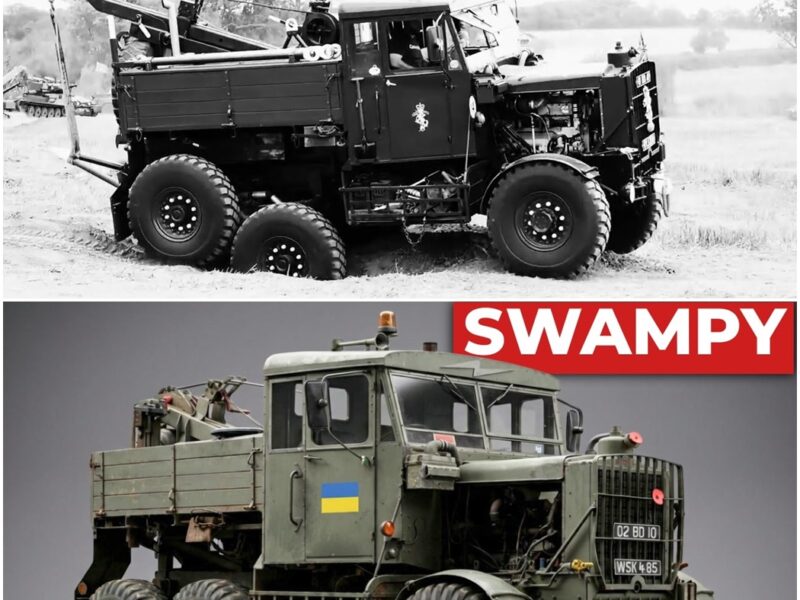
That winch was rated at 8 tons of pull on its own. The recovery variant, the SV2S, added a slewing and extending jib crane capable of lifting 3 tons at its shortest reach, fitted with a separate hand winch for precise positioning. A pair of detachable steel overlay tracks could be bolted over the rear bogie wheels to convert the rear of the vehicle into something approaching a half-track on deep mud or soft sand.
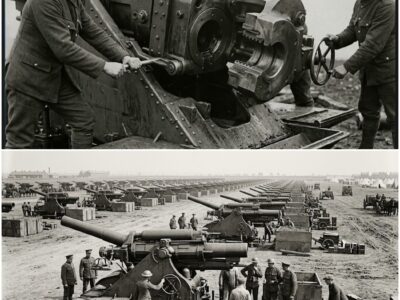
Three principal military variants were produced at Watford across the war years. The R100 artillery tractor was the gun-towing workhorse. Nearly 980 were built. It towed the heavy pieces the Matador and light tractors could not manage. The BL 7.2 inch howitzer, the BL 6-inch gun, American lend-lease 155 mm weapons.
The R100 carried the gun detachment in the cab and on a rear platform along with tools and ammunition. The SV2S heavy recovery vehicle was built in the largest numbers of all three variants. Nearly 1,975 were completed. This was the machine designed to find knocked-out or broken-down armored vehicles and drag them to a repair workshop alive or dead.
The tank transporter variant produced in roughly 459 examples married the Pioneer tractor to a low-loading trailer for moving complete tanks by road. This extended the operational life of tracks, saved fuel, and concealed armored strength from enemy air reconnaissance. Total production across all variants reached approximately 3,400 vehicles by the end of the war.
Sources differ on the precise figure. What is not in dispute is that the Pioneer was everywhere. Now, before moving into the combat record, if you are finding this deep dive into British military engineering worth your time, hit subscribe. It costs nothing, takes a second, and it helps the channel continue this work. October 1942, Egypt.
The Second Battle of El Alamein opened on the 23rd. It was the engagement that Field Marshal Montgomery had promised would not fail. The Eighth Army struck along a front stretching from the Mediterranean coast south into the desert, and the armored battle that followed was violent, attritional, and brutal on machinery as much as on men.
One day before the battle began, on October 1st, 1942, the Royal Electrical and Mechanical Engineers was formally constituted as a corps of the British Army. The REME absorbed repair tradesmen from the Royal Army Ordnance Corps, the Royal Army Service Corps, and the Royal Engineers, uniting all armored vehicle maintenance and recovery under a single command.
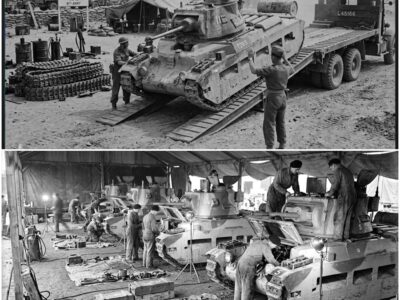
El Alamein was its first battle. The task that faced REME recovery units was vast. The desert floor between the opposing armies was scattered with stricken vehicles. Tanks that had thrown tracks, tanks hit by anti-tank guns, immobilized but repairable, tanks bogged in soft going. Every one of them represented a loss if it could not be reached, assessed, and either repaired forward or dragged back to a workshop.
The Pioneer SV2S was the machine that made that possible at the heavier end of the scale. According to the REME Museum, recovery units retrieved over 1,200 tanks during the Alamein battle, returning more than a thousand of them to fighting condition. These figures, sourced from the museum’s own display material, cannot currently be confirmed against a primary archival document, and may represent the broadest accounting of the operation.
What the Imperial War Museum’s photographic archive does confirm, without dispute, is the Pioneer’s presence throughout the campaign. A photograph dated October 29th, 1942, taken during the battle itself by Sergeant Jim Maffam of the Army Film and Photographic Unit, shows a Scammell Pioneer tank transporter carrying a damaged Sherman tank back from the forward areas.
The battle was still being fought when that photograph was taken. Corporal Roberts, a driver mechanic from Tottenham, London, appears in an Imperial War Museum film of 8th Armored Brigade REME workshops near Sirte, Libya, operating Pioneer equipment in the forward repair area. In the same film, Staff Sergeant Musking of Stoke-on-Trent, described as a fitter, is shown working on the vehicles that the Pioneers had dragged in.
These were not men photographed in rest areas or depots. They were forward. They were close to the guns. By February 1943, the campaign had moved into Tunisia, and Imperial War Museum photograph dated February 12, 1943, taken by Arthur Stubbs, shows a Pioneer SV2S recovery lorry towing a disabled Crusader cruiser tank into a REME workshop in Tunisia.
The Crusader was a vehicle notorious for mechanical fragility. It broke down frequently. The recovery crews earned their pay in North Africa simply by the relentlessness of the work. Field Marshal Montgomery, in remarks recorded and preserved by the National Army Museum, stated that REME would keep the punch in the army’s fist.
He was not using a convenient phrase. He understood, as every armored commander of the war eventually understood, that the army which recovered its damaged tanks faster than the enemy, repaired its own, held a structural advantage that accumulated over weeks and months of attritional fighting. The Pioneer was the machine that made that recovery possible at the heavy end.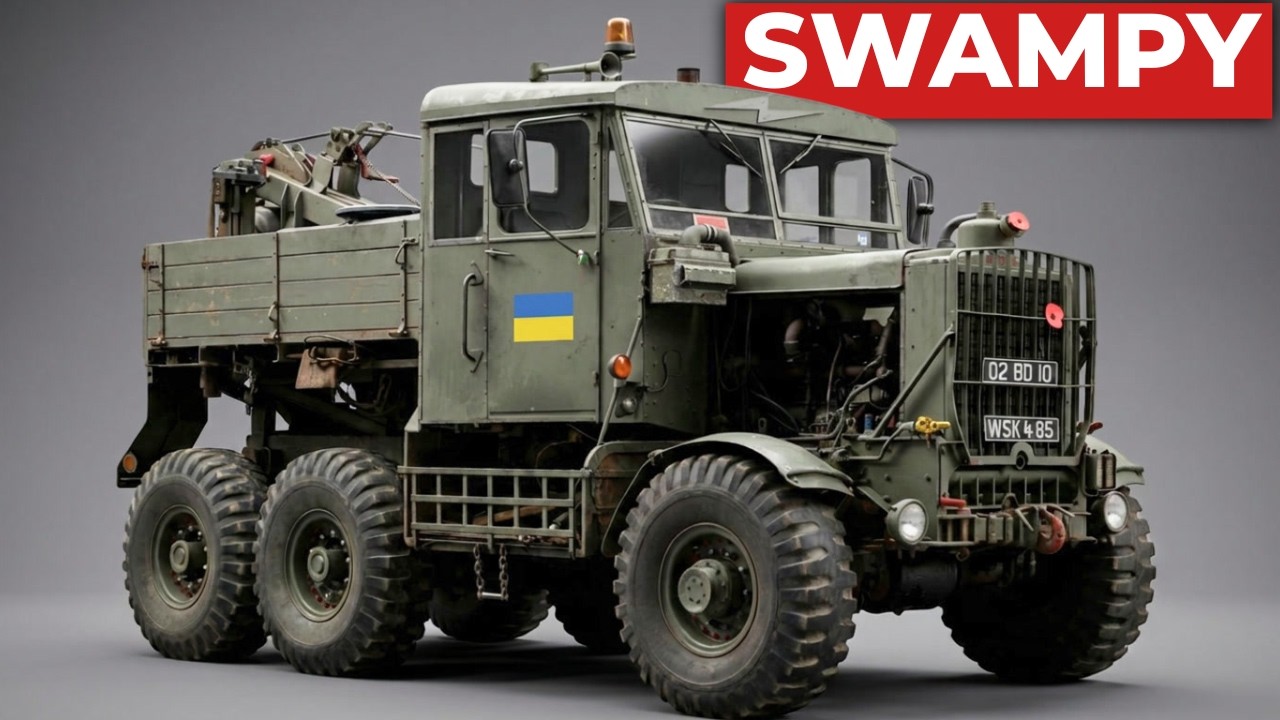
The Germans faced the same problem and solved it differently. Their primary heavy prime mover and recovery vehicle was the Sd.Kfz.9, known as the Famo, the Schwerer Zugkraftwagen, a half-track weighing nearly 18 tons and powered by a Maybach HL108, a 10.8 L water-cooled V12 petrol engine developing 270 horsepower.
On paper, the Famo was far more powerful than the Pioneer. It could pull a theoretical towed load approaching 28 tons. In practice, however, it was a machine of enormous complexity and considerable expense. It consumed aircraft-grade petrol, a fuel that was always scarce in North Africa. It was mechanically demanding to maintain, and the Wehrmacht’s heaviest tanks, the Tiger and the Panther, were beyond the capacity of a single Famo to move.
Moving a Tiger in difficulty required two of them, sometimes four, working in tandem. By the later war years, Famo production was falling, and the vehicle was becoming irreplaceable. The Pioneer had no such problem. Its Gardner diesel could be fueled from the same supply chain that fed the army’s lorries.
Its mechanical simplicity meant that field repairs were achievable with ordinary tools. It was slower than the Famo on the road. It was less powerful, but But was there. It kept working. And when the armored battle was fluid and the workshops were trying to process dozens of vehicles a day, the machine that kept working was worth more than the machine that was theoretically superior.
The Americans eventually solved the heavy recovery and transport problem on an entirely different scale with the M26 Dragon Wagon, a six-wheel drive armored tractor developing 240 horsepower and capable of carrying the heaviest Allied tanks including the Sherman and the Pershing on its trailer. The Dragon Wagon entered service in quantity from 1943 onwards and superseded the Pioneer in the transporter role.
The Diamond T980 was already replacing the Pioneer tank transporter from 1941 because the Pioneer’s trailer could not accommodate the taller, heavier American tanks arriving under Lend-Lease. In the recovery role, American wheeled wreckers supplemented Pioneer strength in northwest Europe. None of this changed the Pioneer’s status in the Royal Artillery towing role where it continued to haul the heaviest British guns until the end of the war. Italy, 1943 to 1945.
The Italian campaign offered terrain that punished machinery and broke men. Mud that swallowed wheeled vehicles. Mountain roads barely wide enough for the Pioneer’s 8-ft 6-in body. The heavy regiments of the Royal Artillery towing their 7.2-in howitzers up gradients that challenged any machine were dependent on the Pioneer’s low-speed torque and the walking beam bogie’s ability to keep all wheels on broken ground.
The 6th Armoured Division, which fought through the Gothic Line in 1944 and into the Po Valley in 1945, depended on Pioneer recovery vehicles to retrieve the Shermans and Churchills that the anti-tank defenses of the German line disabled in numbers. Each vehicle recovered and returned to its unit reduced the pressure on a supply chain already stretched across mountain passes.
The Pioneer did not excel in Italy by being fast. It excelled by not stopping. On roads where German demolitions had collapsed bridges and cratered surfaces, the walking beam bogie found traction where a conventional rear axle would have spun uselessly. It was ungainly. It was slow. It was exactly what the terrain required. Normandy, June 1944.
The 22nd Armoured Brigade Workshop of REME landed in France with Pioneer Recovery Vehicles as part of the 7th Armoured Division’s Maintenance Train. The bocage fighting that dominated the early weeks of the Normandy campaign was catastrophic for armor. Tanks brewed up in narrow lanes with no room to maneuver.
Shermans hit by 88-mm fire burned where they stood, blocking the routes forward. The work of dragging stricken vehicles out of the bocage and back to a workshop, usually at night, under the constant risk of air attack or artillery concentrations on known road junctions, fell to recovery crews in vehicles like the Pioneer.
The noise of a Pioneer working in the dark, its winch drum grinding under load, was a sound the infantry on the hedgerows came to associate with the knowledge that someone was still trying to save what could be saved. The work was not glamorous. It was systematic and exhausting. It continued every night the campaign moved forward.
As the breakout came in late July and August of 1944, and the 7th Armoured Division raced east through France, the Pioneer’s role shifted from the attritional recovery of bocage casualties to the maintenance of a mobile advance, keeping the guns moving, keeping the workshop’s work product back in the fight before the army outran its own supply.
By the time Allied forces crossed into Germany in the spring of 1945, the Pioneer had served on four separate major campaigns on three continents. It had towed guns that shook the ground for miles around. It had dragged tanks that other vehicles could not budge. It had done this in desert heat, Italian mud, the ruins of French villages, and the broken roads of the Reich itself.
The question of what replaced the Pioneer is not straightforward. In the towing role, heavier and more powerful British tractors took over the heaviest pieces in the early 1950s. The Scammell Explorer, a new design sharing the Pioneer’s general layout but fitted with a Meadows petrol engine and six-wheel drive, entered service from 1950 as the official replacement for the recovery Pioneer.
726 were delivered to the British Army and Royal Air Force. In the tank transporter role, the American Diamond T and then the Thornycroft Antar eventually took over completely. The Pioneer, however, refused to disappear. The machine had a quality that replacement vehicles did not always inherit, which was the trust of the men who used it.
Surplus Pioneers entered civilian service across Britain in fairground haulage, timber transport, heavy industrial work. They ran for decades. The military versions lingered in secondary and reserve roles across the Commonwealth, in New Zealand, in South Africa, and in small British garrisons far from Germany.
The last military Pioneer in British service was a recovery vehicle, given the informal name Swampi, operated by British forces in Belize, the former British Honduras, where it had been working in jungle and tropical conditions for years. Swampi was finally withdrawn from service in the 1980s. It was not scrapped.
It was returned to Britain, rebuilt at 43 District Workshop R E M E in Aldershot, and placed in the collection of the R E M E Museum, where it remains today as the most mechanically honest monument to what the Pioneer actually was. Not a sophisticated machine, not a fast one, not an elegant one, but one that worked and kept working when everything depended on it.
Preserved examples survive in museums and private hands across Britain. The sole surviving SV1Z, the earliest recovery variant, is believed to exist in a national collection. The Pioneer tank transporter tractors are rarer. Their trailers almost entirely scrapped after the war. The Scammell register maintains records of surviving examples and restorations across civilian and military variants.
Return, then, to the factory floor in Watford, 1937. That machine rolling out of the Scammell shed on Tolpits Lane. Eight long tons, 102 horsepower. 24 mph at full throttle on a flat road. No armor, no weapons. It could not protect itself. It had no night vision, no communications equipment of its own, no ability to fight back.
In the desert, it needed its own recovery when it bogged down in soft sand. In Italy, it was almost too wide for the mountain tracks it was expected to use. In Normandy, its crews worked in darkness under the constant threat of artillery, and yet it towed guns that nothing else could move. It recovered tanks that would otherwise have been lost permanently.
It dragged the Eighth Army across North Africa and the 14th Army across Burma. According to the REME Museum, more than 1,000 tanks were returned to battle at El Alamein alone, with Pioneer Recovery Vehicle central to that operation. It served for nearly 50 years. A single example named Swampi was considered worth shipping across the Atlantic rather than abandoning to the jungle. That is not sentiment.
That is evidence. The Scammell Pioneer was not glamorous. It was not a weapon. It did not destroy anything. It did not appear on the front pages of newspapers or in the newsreels shown to waiting cinema audiences back home. The men who drove it and operated its winch and crane worked in darkness and in noise and in danger without recognition.
But the guns fired because the Pioneer pulled them there. The tanks fought because the Pioneer brought them back. That was the most important thing a vehicle could be in the war that the Eighth Army fought, and it was the most important thing a vehicle could be in any war. It was British, and it worked when it mattered.