The ‘Tiny’ British Tracked Carrier That Fought On Every Front Of WW2 And Refused To Die D
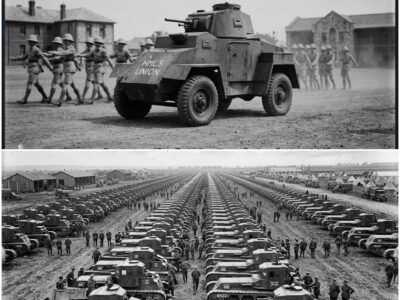
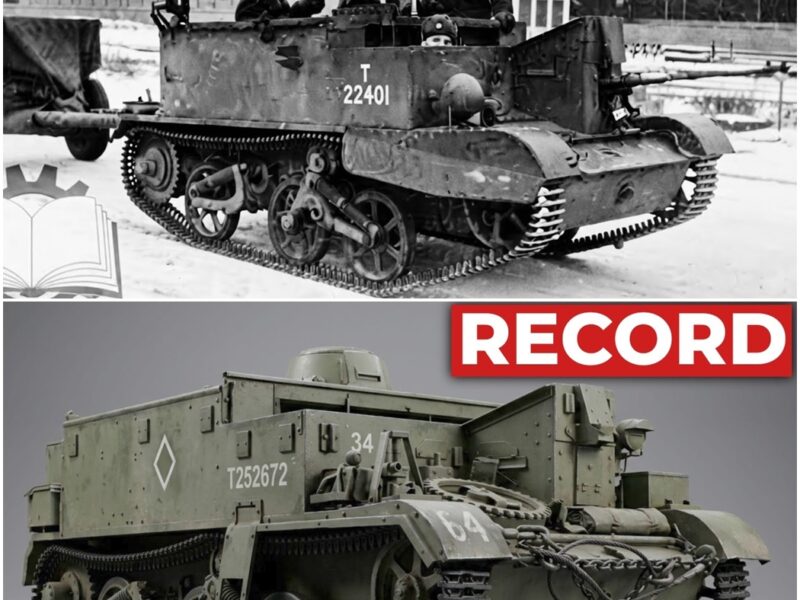
1934, the Vickers-Armstrong’s factory, Elswick, Newcastle upon Tyne. A small steel box rolls out of the workshop on tracks. It is barely 12 ft long. It stands no higher than a man’s chest. Its armor is thinner than two stacked coins. There is no turret. There is no roof. The crew sit in the open air exposed to everything, wrapped in nothing but a few angled plates of mild steel that would not stop a heavy rifle round at close range.
Everyone who saw it that day thought the same thing. It looked too small. It looked too light. It looked unfinished. finished, like a tracked cart that someone had forgotten to complete before sending it out the door. But that vehicle, and the 113,000 machines descended from it, would go on to fight in every theater of the Second World War.
They carried machine guns through the Western Desert. They waited ashore onto the beaches of Normandy. They dragged ammunition through the jungles of Burma and clawed across the volcanic dust of the Pacific Islands. They towed artillery in Italy, evacuated wounded in the Scheldt, and fired jets of burning fuel into German bunkers across Northwest Europe.
They served in 30 nations across four decades. The last of them was not scrapped until 1965, 30 years after the design was born. Its name was the Universal Carrier. Every soldier who ever crewed one called it the Bren Gun Carrier, and it was the most produced armored fighting vehicle in the history of warfare.
To understand why the Universal Carrier existed, you need to understand the problem Britain faced in the years between the two World Wars. The infantry battalion was still organized around the lessons of 1918. The Bren light machine gun had replaced the Lewis gun as the section’s primary automatic weapon.
It was accurate, reliable, and devastating in the right hands. But it was also heavy, and the men who carried it into battle arrived exhausted before they fired a single round. The army needed a vehicle that could bring the Bren to the edge of the fighting, deliver it fast, and then get back out of the way.
The solution came from a lineage of small tracked machines that stretched back to the Carden Loyd Tankettes of the 1920s. Sir John Carden, the designer at Vickers-Armstrong’s who had absorbed the original Cardon Lloyd firm, understood that a light tracked vehicle needed to be something no tracked vehicle had ever properly been.
Cheap enough to produce by the thousands, simple enough to maintain in the field, and flexible enough to do more than one job. His answer was a design built around the Ford flathead Ford 8 engine, a commercial power plant that every mechanic in the Commonwealth already knew how to fix. He gave it a distinctive steering system using a vertical wheel that displaced the front bogey rather than braking one track against the other.
That single engineering decision made it faster and more intuitive to drive than anything the army had operated before. Cardon himself was killed in an air crash near Tatsfield in December 1935, before his machine reached mass production. He never saw what he had created. The first contracts were placed in April 1939.
By that point, the War Office had already replaced four separate, near identical carrier types with one standardized design. That was the meaning of the word universal, not that it did everything, but it replaced everything. The Bren carrier, the Scout carrier, the Cavalry carrier, the Medium Machine Gun carrier, all were collapsed into a single interchangeable hull.
Factories could now run one production line instead of four. The vehicle that emerged was 11 ft 9 in long and 6 ft 9 in wide. It weighed just under 4 tons. The Ford V8 produced 85 horsepower and pushed it to 30 mph on a good road. The armor ranged from 7 to 10 mm across the hull. 7 to 10 mm. That measurement is not a typo.
It was proof against rifle fire and shell splinters, nothing more. The carrier was never intended to fight from the vehicle. The crew would bring the weapon forward, dismount to engage, and recover. That was the theory. The reality of 6 years of war looked very different. In the field, the carrier became something the designers never specified and the War Office never planned for.
Crews mounted Vickers medium machine guns in place of Brens. They bolted Boys anti-tank rifles to the hull. They welded extra ammunition bins wherever they could find space. They strapped radios to the back bench and turned the vehicle into a rolling observation post. They loaded it with mortar rounds and used it as a pack animal for the 3-in mortar teams behind them.
They laid telephone cable from its rear. They loaded stretchers onto its sides and used it as an ambulance under fire. Some crews mounted twin Browning machine guns stripped from crashed aircraft and created impromptu anti-aircraft platforms. The carrier did not have a defined role. It filled whatever role the situation demanded. That was the real meaning of universal.
Production expanded to a scale that no one had anticipated. British factories produced approximately 57,000 during the war years. Canada added another 29,000. Built by Ford Motor Company of Canada, the United States contributed roughly 20,000 more under Lend-Lease arrangements. Australia built 5,600 of a locally designed pattern with a welded hull and simplified steering.
New Zealand produced 1,300 by the time production finally ceased in 1960. Total output across all manufacturers and all nations stood at approximately 113,000 vehicles. No armored fighting vehicle in history, not the T-34, not the Sherman, not the Panzer 4, was built in greater numbers. Now, before the combat record.
If you are finding this deep dive into British military engineering worth your time, hit subscribe. It costs nothing and it is the best thing you can do for this channel. January 1943. The Mayu Peninsula, Burma. A place called Don Baik. The Japanese had fortified the beach at Don Baik into a network of concealed bunkers connected by tunnels that artillery could not destroy and infantry could not reach without being cut down in the open.
The carrier platoon of the 5th Battalion, 8th Punjab Regiment, was trying to support an attack along the beach. On January 6th, two carriers were hit by Japanese fire and disabled in the open. Their crews were stranded. Havildar Parkash Singh, commanding a third carrier, drove forward under fire and pulled the two crews out.
13 days later, on January 19th, three more carriers were disabled by a Japanese anti-tank gun on the same stretch of open beach. The combined crews had used their ammunition and were now pinned in their crippled vehicles as Japanese infantry advanced on foot across the sand. Parkash Singh went out again.
He brought his carrier forward under direct fire, loaded the crews aboard, and then dismounted in the open to attach a tow chain to one of the disabled vehicles. Two wounded men were still inside it. He dragged it back to safety with them aboard. For those two actions at Don Baik, Havildar Parkash Singh was awarded the Victoria Cross.
He was later commissioned and retired from the army as a major in 1968. His citation is held at the Imperial War Museum in London. His name belongs next to the vehicle that gave him the means to go back twice when any rational calculation said once was already too many times.
Burma was the theater that revealed the carrier’s real limits and its real virtues simultaneously. The jungle swallowed wheeled vehicles. The carrier’s tracks kept it moving across ground that stopped half-tracks and trucks outright, but the open crew compartment offered no protection from the canopy above where snipers fired down and the thin hull provided nothing against the anti-tank weapons the Japanese had pre-positioned at every choke point.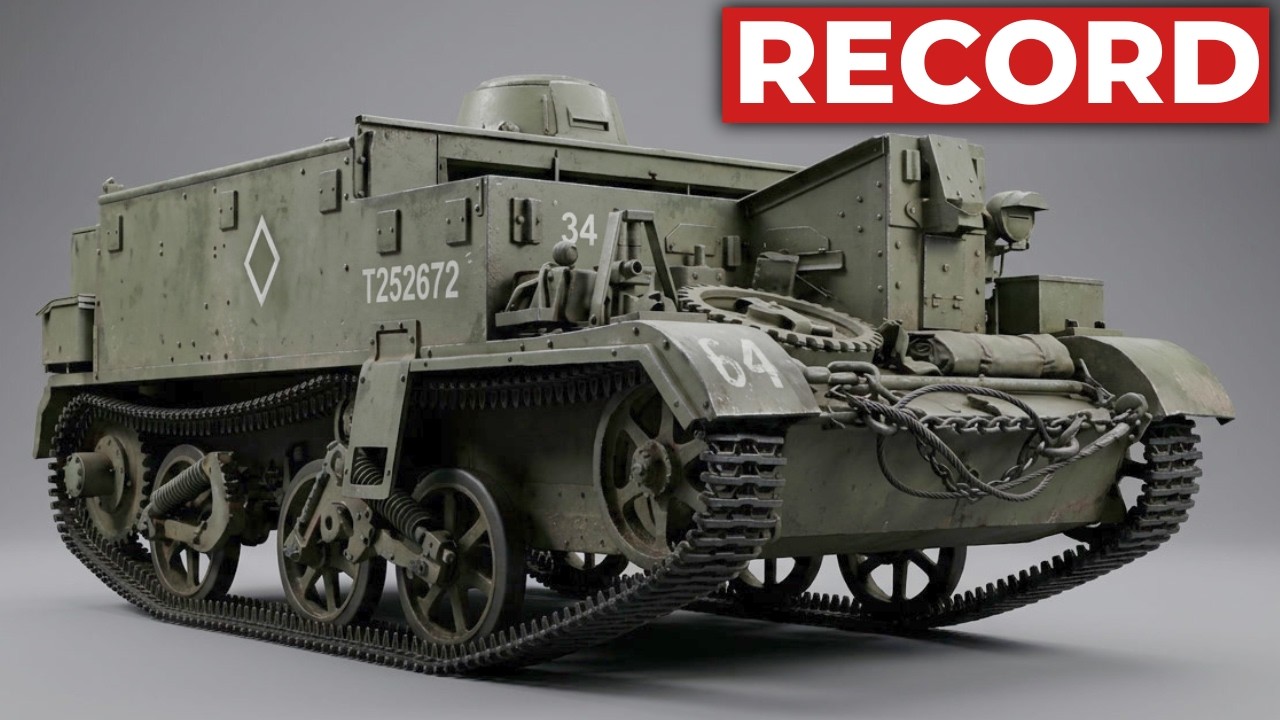
Crews learned to drape sandbags over the floor to absorb mine blasts. They learned to move fast and never stop in the open. The carrier’s survival in Burma depended entirely on the skill and nerve of the men inside it. In the Western Desert, the calculus was different. The Australian 9th Division, which had held Tobruk through 1941, deployed carrier platoons at the Second Battle of El Alamein beginning October 23rd, 1942.
The 9th Division’s Cavalry Regiment fielded 52 Bren Gun Carriers alongside its tanks. In the desert, the carrier’s speed and low profile made it effective for reconnaissance, for covering the flanks of infantry advances, and for running ammunition forward under fire along routes that larger vehicles could not take without drawing immediate attention from German anti-tank guns.
Field Marshal Bernard Montgomery, who commanded the 8th Army through El Alamein and beyond, said later that he could not have won that battle without the 9th Australian Division. Their carriers were part of what made that division what it was. In Italy, carriers came ashore at Sicily on July 10th, 1943, and at Salerno on September 9th.
A crew of the 2nd Sherwood Foresters was photographed in the Anzio bridgehead in April 1944, firing a 2-in mortar from their carrier while the bridgehead was still being contested on all sides. New Zealand carrier platoons in Italy took their personal armament to extremes, mounting Browning, Vickers, and Besa machine guns wherever the hull could bear the weight.
By April 1945, New Zealand carrier platoons were also operating the flame thrower variant. That variant deserves its own accounting. The Wasp was the Universal Carrier stripped of its standard weapons and fitted with a flame thrower transportable number two. The final version, the Mark II Charlie, mounted a 75-gallon fuel tank externally at the rear and a projector at the co-driver’s position.
It could project burning fuel across open ground and into confined spaces that no other weapon could reach efficiently. It entered action in Normandy in July 1944. What happened next was not anticipated in any tactical manual. German infantry opposition frequently collapsed on sight, not after the weapon fired, on sight.
The psychological effect of a tracked vehicle approaching at speed, trailing fuel lines, with a projector visible on the hull, was enough to force surrenders that infantry assaults and artillery had failed to produce. In the autumn of 1944, during the Battle for the Scheldt Estuary, Canadian forces massed 27 Wasp flamethrowers on the bank of the Leopold Canal.
They fired continuously for 5 minutes to cover the Royal Montreal Regiment’s crossing. The far bank, which had been held against repeated infantry attacks, was cleared. The Wasp was not a weapon of last resort. It became, wherever it appeared, the the weapon of first choice. Against all of this, the Germans fielded the Sd.Kfz. 250.
The Sd.Kfz. 250 was larger, better armored with sloped plating, and carried a full scout section. It mounted heavier weapons up to a 75 mm gun in some variants. On paper, it was clearly superior. In practice, the comparison was almost meaningless because Germany never came close to producing the numbers that made the Universal Carrier what it was.
German half-track production, across all variants, reached approximately 66,000 vehicles during the entire war. Britain, Canada, Australia, and the United States produced 113,000 Universal Carriers. Numbers are a kind of armor. The Carrier wore its numbers like plate steel. The Americans offered the M3 half-track as the more direct comparison.
The M3 was larger, faster on roads, and could carry a full infantry squad. It was also partly wheeled at the front, which limited its cross-country performance on soft ground and in mud. The Universal Carrier was fully tracked from the first road wheel to the last. In the Burmese jungle, in the Italian hills, in the low fields of the Scheldt, that difference was decisive.
After 1945, the Carrier did not retire. It spread. Israel and Egypt both fielded Carriers in the 1948 Arab-Israeli War. Egypt deployed more than 100 of them in Palestine, organized into heavy weapons platoons. Israel captured a number and turned them against their previous owners.
Egypt used them again in the Suez Crisis of 1956. The Netherlands operated Carriers through the Indonesian National Revolution of 1945 to 1949. West Germany received 100 ex-British Carriers in 1956 when the Bundeswehr was reconstituting. Ireland operated more than 200, maintained through the 1950s and into the early 1960s. The last documented military retirement came in October 1965 when the remaining Irish Army Carriers were delivered to the Hammond Lane Foundry in Dublin and scrapped.
The design had been in continuous military service for 31 years, 1934. Elswick, Newcastle upon Tyne. That small steel box on tracks, the one that looked too small, too light, too unfinished to be taken seriously. It had no turret, it had no roof, its armor could not stop a heavy rifle round at 50 yards. It carried three men and a machine gun and was supposed to deliver them to the edge of the fight and then get out of the way.
It was underpowered by the standards of every vehicle that replaced it. It offered no overhead protection in any terrain. It was open to weather, to air burst, to sniper fire from above. In the desert it cooked its crew. In Burma it offered no cover from the trees. In Normandy it could be knocked out by a machine gun firing armor-piercing rounds at close range.
Its limitations were not minor, they were structural. And yet it fought in the Western Desert and in the hills of Italy, and on the beaches of Normandy, and in the jungles of Burma, and on the islands of the Pacific, and in the streets of Palestinian cities, and across the waterways of the Netherlands, and through the forests of Northwest Europe.
113,000 of them. No armored vehicle in history was ever built in greater numbers. Not by Britain, not by Germany, not by the Soviet Union, not by the United States, not by anyone. The genius of the Universal Carrier was not armor, it was not firepower, it was not speed. It was the understanding arrived at early and held to throughout 30 years of production that the most valuable thing a battlefield vehicle could be was everywhere at once.
Britain built it small enough to be cheap. Cheap enough to build by the hundred thousand, numerous enough to be present at every engagement on every front in every theater for six years without ever running short. And when the war ended, numerous enough to equip 30 nations for another two decades before the last one was finally cut up for scrap.
That is not fortune, that is not accident, that is British industrial logic applied to war.