What REALLY Happened to Britain’s Royal Air Force’s First Aircraft After WW1 D
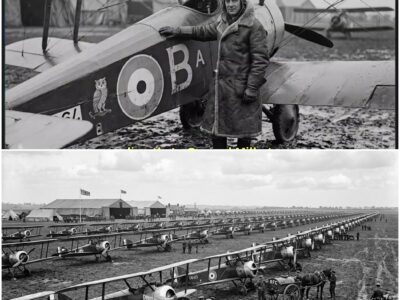
By November 1918, official returns placed the strength of the world’s newest air force at more than 22,000 aircraft spread across 188 operational squadrons from airfields on the Western Front to training grounds in Egypt and Mesopotamia. The Royal Air Force, barely 7 months old, had been formed on 1st April 1918 through the merger of the Royal Flying Corps and the Royal Naval Air Service and in doing so had assembled the largest air fleet the world had ever seen.
Behind those numbers stood thousands of Sopwith Camels, SE5As, Bristol Fighters, Airco DH4 and DH9 bombers, and the great twin-engined Handley Page O/400s, all built at extraordinary speed and expense to win a war that had just, quite suddenly, ended. Within 18 months, almost the entire fleet would be gone, scrapped, sold, given away, or burned on airfield bonfires whilst a nation exhausted by 4 years of war turned its attention to economy rather than empire in the sky.
The scale of what the RAF held at the armistice was staggering, and so was the speed with which the Treasury wanted it reduced. Squadrons that had flown daily sorties over Flanders in October 1918 were being disbanded or reduced to cadre strength within weeks. Personnel numbers, which had peaked at close to 300,000, fell to under 100,000 by the end of 1919 and would fall further still.
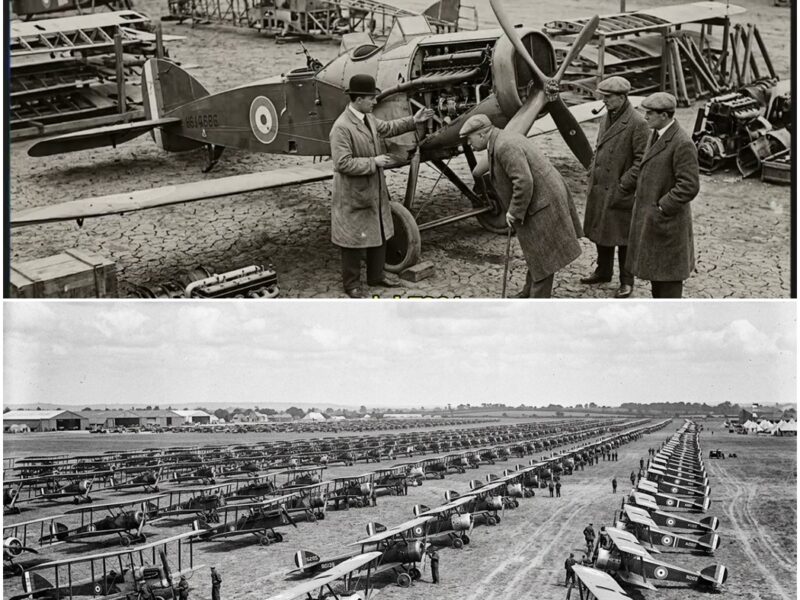
Aircraft sat wingtip to wingtip at storage depots such as Ascot, Yatesbury, and the great aircraft acceptance park at Duxford, whilst others remained abroad in France, Palestine, and Mesopotamia, their fate undecided. Some machines were barely months old, others had seen hard service and bore the patched fabric and oil-streaked cowlings of a summer of continuous fighting.
The government faced an immediate question that would occupy the Air Ministry for the next 3 years. What should be kept to preserve an independent air force against political attack? What should be sold to recoup some fraction of wartime expenditure? And what should simply be destroyed as surplus that nobody could afford to store, maintain, or insure? Air Marshal Hugh Trenchard, determined that the fledgling service should survive the peace, argued that a small professional core had to be retained regardless of the wider disposal of wartime stock. And it was this argument, made through 1919 and into the early 1920s, that ultimately preserved the Royal Air Force as a separate service when the Army and Navy pressed for its absorption. But preserving the institution did not mean preserving the aircraft. Of the machines on charge at the armistice, the overwhelming majority were wartime pattern types considered obsolete or economically unviable to maintain. And the disposal of this enormous surplus became one of the largest logistical undertakings of the immediate post-war years, arguably larger in scale, if less discussed, than the disposal of
surrendered German equipment being handled by the Inter-Allied Aeronautical Commission of Control across the Rhine. The first and largest channel for disposal was direct sale through the Aircraft Disposal Company, formed in 1920 and based principally at Croydon and at the former RAF station at Waddon, where vast stocks of airframes, spare parts and engines were assembled for public auction.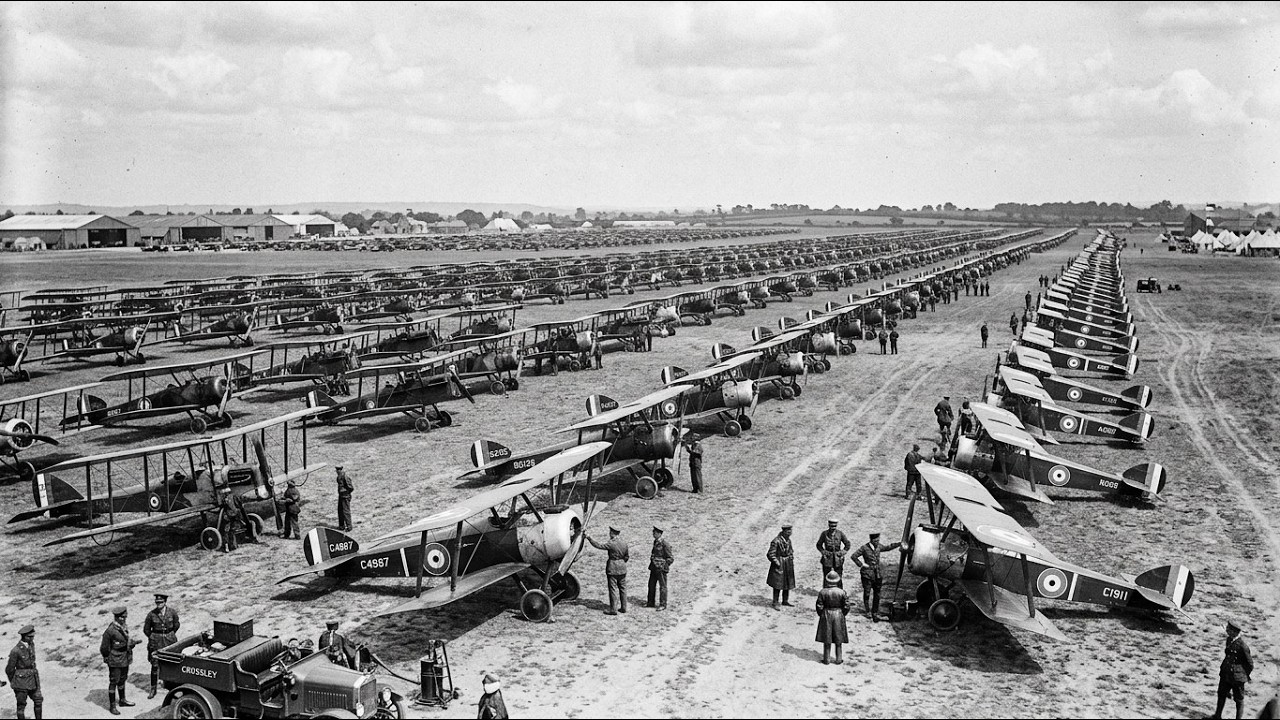
The company, chaired by Frederick Handley Page and staffed largely by former RAF officers, took on the task of clearing what the Air Ministry itself could not use. And it did so on a scale almost impossible to picture today. Thousands of airframes passed through its hands, some sold whole to civilian flying schools and private owners, others broken for their Rolls-Royce, Wolseley or Bentley rotary and inline engines, which retained genuine commercial value long after the wooden airframes around them had become worthless. Complete SE.5a’s could be purchased for a few hundred pounds, whilst Bristol Fighters, valued for their robust construction, found buyers among the small but growing number of civilian pilots eager to keep flying now that wartime flying pay had vanished. Newspapers of the period carried advertisements for surplus aircraft alongside advertisements for surplus motor lorries and field kitchens, a striking indication of how quickly the tools of aerial warfare had become simply another category of government surplus stock. Overseas theaters presented their own particular disposal challenges, quite separate from those faced at home.
Squadrons operating in Mesopotamia and Palestine having supported the final campaigns against Ottoman forces found themselves maintaining aircraft thousands of miles from any factory or major depot in climates that punished wooden airframes and doped fabric far more severely than the temperate conditions of home establishment stations.
Many machines in these theaters were simply flown until they could fly no longer, their maintenance schedules abandoned as spare parts stopped arriving, and were then stripped of anything useful and left where they stood. In France, squadrons withdrawing from former frontline airfields left behind hangars, workshops, and stores that French authorities inherited wholesale.
Whilst airworthy aircraft judged not worth the cost of a return flight across the channel where occasionally sold locally rather than transported home, a further quiet drain on the wartime total that rarely appears in official disposal figures. A second and rather more deliberate channel for disposal was the Imperial gift scheme announced in 1919 under which the British government transferred substantial quantities of aircraft, engines, and equipment to the Dominions as the foundation stock for their own independent air arms. Australia received 128 aircraft under the scheme forming the nucleus of what would become the Royal Australian Air Force in 1921. Canada received more than 100 machines which directly underpin the establishment of the Canadian Air Force and later the Royal Canadian Air Force. South Africa and New Zealand received smaller but still significant allocations, whilst India, then still administered as part of the Imperial defense structure, received aircraft to support the expansion of the Royal Air Force presence on the Northwest Frontier. The types transferred were overwhelmingly wartime designs, Avro 504
trainers, DH9 bombers, and SE5A fighters chief among them. And whilst the scheme was framed publicly as an act of Imperial generosity, it also served the more practical purpose of removing thousands of aircraft from British storage depots at no cost to the Treasury beyond that of transport. A third and commercially significant channel lay in the conversion of surplus wartime bombers into some of the very first airliners operated anywhere in the world.
Handley Page O/400 bombers, stripped of their military equipment and fitted with primitive passenger cabins, were flown by Handley Page Transport on some of the earliest scheduled international air services, including routes between London and Paris beginning in 1919. The Airco company and its successor de Havilland converted DH.4 and DH.
9 airframes for early mail and light transport work, whilst Aircraft and Travel, another pioneering operator, relied heavily on cheaply purchased ex-military stock to establish itself in an industry that otherwise had no aircraft, no infrastructure, and no precedent to draw upon. In this respect, the disposal of RAF wartime aircraft did not simply represent an ending.
It represented quite directly the beginning of British civil aviation, an industry built almost entirely on the bones of a wartime air force that the country could no longer afford to keep flying in uniform. If you are finding this look at how the Royal Air Force’s wartime fleet actually disappeared interesting, do consider subscribing, as there’s a great deal more of this overlooked post-war history still to come.
For every aircraft sold or gifted, a far larger number met a far less dignified end. The overwhelming majority of RAF wartime stock, likely well in excess of 80% by most contemporary estimates, was simply destroyed. Wood and fabric airframes with no commercial buyer were broken up and burned in controlled bonfires at storage depots across the country, a practice recorded at several former aircraft acceptance parks where columns of smoke rose for weeks as unsold stock was cleared to make way for the return of agricultural land or the closure of temporary wartime facilities. Engines that could not be sold were stripped for scrap metal. Their aluminum and steel components fed into a post-war economy desperately short of raw materials for reconstruction. Airframes that had survived combat entirely intact were destroyed, not because they had failed in any technical sense, but because a Treasury determined to reduce wartime expenditure judged that the cost of storage and maintenance simply could not be justified for machines whose military value had
already been overtaken by rapid advances in aircraft design during the war’s final year. Depots at Yatesbury, Ascot, and elsewhere processed thousands of airframes in this manner through 1919 and 1920. And by the time the worst of the disposal program concluded, the RAF’s frontline had shrunk from those 180 eight squadrons of November 1918 to barely 33 by 1920.
A contraction so severe the Trenchard himself later described the service as having been reduced to what he called a mere skeleton of its wartime self. What survives today is, by any measure, a remarkably small fraction of that vast wartime inventory. And the examples that do exist are treasured accordingly. The Royal Air Force Museum at Hendon holds one of the world’s most significant collections of First World War airframes, including a genuine Bristol F.2B fighter and an S.E.
5A, both drawn from the handful of machines that escaped the disposal program through transfer to training or instructional use rather than outright sale or destruction. The Shuttleworth Collection at Old Warden in Bedfordshire maintains an S.E.5A serial F.904 in genuinely airworthy condition, one of the very few First World War fighters anywhere in the world still capable of flight, alongside a Sopwith Pup that likewise still takes to the air at seasonal displays.
The Imperial War Museum’s site at Duxford preserves further examples, including a Sopwith Camel. Whilst the Science Museum in London holds additional airframes and components recovered or preserved through separate institutional channels over the intervening century. Many surviving machines owe their existence not to deliberate preservation policy, but to simple accident.
An airframe retained for instructional purposes at a training school, an engine kept as a demonstration piece, a fuselage stored in a private hangar and simply never scrapped. Restoration of these survivors remains painstaking work given the scarcity of original wartime components, and each confirmed genuine wartime airframe, as opposed to a later reproduction, is now considered an object of considerable historical and financial value.
The legacy of this rapid dismantlement is twofold. On one hand, the almost total destruction of Britain’s wartime air fleet represents a genuine loss to historical record. A fleet larger than anything previously assembled reduced within a couple of years to a scattering of museum pieces and a handful of airworthy veterans.
On the other hand, the disposal program, chaotic and financially driven as it was, directly seeded both the Dominion Air Forces that would fight alongside Britain a generation later and the earliest civil airline industry, giving surplus wartime engineering a genuinely productive second life. The political battle that Trenchard fought to preserve the Royal Air Force as an independent service, even as its aircraft were being sold off around him, ensured that the institution itself survived the very disposal process that consumed almost everything it had flown. The fleet of 22,000 aircraft that stood ready in November 1918 had, within a few short years, been reduced to smoke, scrap metal, a scattering of civil airliners, the founding stock of new Dominion Air Forces, and a handful of genuine survivors now kept under careful climate control in national collections. It stands as a striking reminder of how quickly even the most formidable wartime technology can vanish once the war that produced it has ended. If you found this video insightful, watch what happened to Germany’s surrendered aircraft after the First
World War next. It explores how thousands of Fokker, Albatros, and Gotha machines were seized by Allied Technical Commissions, tested at proving grounds across France and Britain, and almost entirely destroyed under the terms of the Treaty of Versailles. Like this video, subscribe, and hit the bell for more. Thanks for watching.