Why This ‘Absurd’ British Trench-Cutter Terrified Everyone Except The Germans D
November 1941, Clumber Park, Nottinghamshire. Winston Churchill steps out of his car and walks nearly a mile through ankle-deep mud to reach a fenced-off test site hidden inside a former ducal estate. He has come to see something no one outside a tiny circle of engineers and military officers knows exists. It is 77 ft long.
It weighs 130 tons, and it is designed to do something no machine in history has ever done, carve a fully protected infantry trench across no-man’s-land while under fire. The Prime Minister watch as the machine lurches forward and bites into the earth. Soil erupts from conveyor belts on its back, piling into neat banks on either side.
Behind it, a clean trench stretches into the distance 7 ft 6 in wide, 5 ft deep, enough for soldiers to walk upright with full kit. Churchill later described the performance as having astonishing efficiency. He’d been waiting 25 years for this moment because this machine was not born from the Second World War.
It was born from the first. Churchill returned to the Admiralty on September 3, 1939 carrying a terror that had never left him. He had seen the Western Front. He knew what happened when armies dug in and faced each other across open ground. Hundreds of thousands dead for a few hundred yards of churned earth.
Now, the Germans had built the Siegfried Line. The French sheltered behind the Maginot Line. Every sign pointed toward another stalemate, another generation fed into the wire. During the First World War, Churchill had already imagined a mechanical trench digger, but he could not get the idea accepted.
He had succeeded with a different radical concept instead. As First Lord in 1915, he established the Land Ships Committee and authorized £70,000 for armored tractors. Those tractors became the first tanks deployed at the Battle of Flers-Courcelette on September the 15th, 1916. Now back in the same office 24 years later, he repeated the same institutional trick.
He bypassed the army entirely and turned to the director of naval construction, Sir Stanley Goodall. Churchill’s vision was enormous. He imagined 200 to 300 machines deployed along a 20 to 25-mi front, cutting communication trenches through the night. By dawn, an overwhelming force would be established inside German defenses with hundreds of protected approach routes stretching back behind them.
Churchill delegated the project to J. H. Hopkins, a distinguished ship designer. Hopkins put a young marine engineer named Frank Spanner in charge of the actual design work. The team set up in the Grand Pump Room Hotel in Bath, the wartime home of the Naval Construction Department, with some of the most sensitive work done secretly in the hotel cellars.
By late 1939, the model-making firm Bassett-Lowke of Northampton had built a 4-ft working scale model. On December 12, 1939, this model was demonstrated to Churchill at the Admiralty using simulated soil made from sawdust and plasticine. An observer noted that his smile of pleasure almost dislodged his cigar.
That same evening, Churchill arranged a second demonstration for Prime Minister Neville Chamberlain, the Chancellor Sir John Simon, and Chief of the Imperial General Staff Sir Edmund Ironside. According to Ironside’s diary, he found the concept compelling and thought it presented the first possible offensive idea.
The mahogany case used to carry the model to London resembled a small coffin. Legend has it that, as it was carried through Bath railway station, bystanders bowed their heads in respect, believing a child’s remains were being transported. Whether true or not, the story spread among the project team and became part of the machine’s mythology.
On January 22, 1940, an official order was placed with Ruston & Hornsby of Lincoln, a firm that specialized in heavy excavating equipment. On February 7, the Treasury approved production of 240 machines, 20 narrow infantry versions, and 40 wider officer versions designed to accommodate tanks. The production target was 20 machines per week.
The original design called for a single Rolls-Royce Merlin engine producing around 1,000 horsepower, but the Air Ministry reserved every Merlin for Spitfires and Hurricanes. The engine consultant Sir Harry Ricardo, recommended an alternative, two Paxman 12 TP diesel engines, each rated at 600 brake horsepower, manufactured by Davey Paxman and company of Colchester.
This forced a complete redesign that made the machine larger and heavier. The Paxman 12 TP was a V12 high-speed diesel running at 1,500 RPM with a bore of 7 in and a stroke of 7 and 3/4 in. Its innovative modular construction allowed components to be manufactured across more than 400 subcontractor firms.
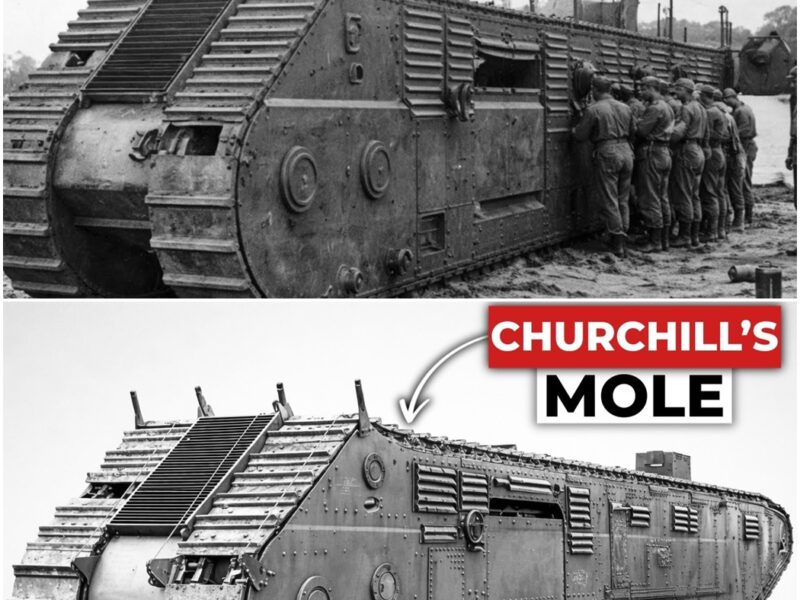
The finished machine was unlike anything ever built. At the front, a large plow blade removed the upper 2 ft 6 in of soil. Behind and below it, a rotating cutting drum removed the lower 2 ft 6 in. Spinning perpendicular to the direction of travel, conveyors running along the top of the machine deposited excavated spoil in banks on both sides, while wings on the plow pushed debris clear of the trench edges.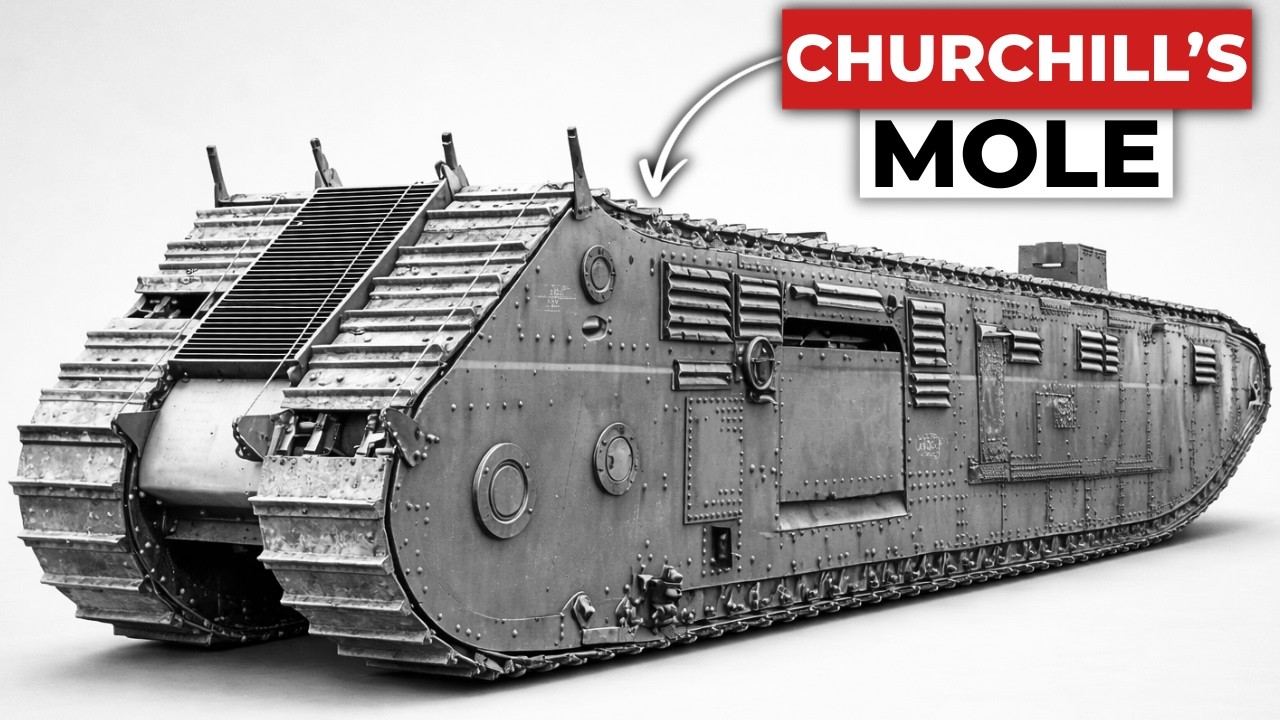
The result was a fully formed trench with the spoil banks adding roughly 2 to 3 ft of additional effective depth above ground level. The machine ran on 2-ft wide tracks wrapping around its entire body in the style of a World War I rhomboid tank. A crew of three operated it from an armored conning tower, a driver, an engineer, and a navigator.
Digging speed was approximately half a mile per hour, shifting roughly 8,000 tons of soil. Surface speed without digging reached just over 3 mph forward and about 1 and 1/2 mph in reverse. The project cycled through several code names to conceal its purpose. It began as white rabbit number six, likely a nod to the Lewis Carroll character who disappears down a hole.
It became cultivator number six for better cover, then NLE tractors after the Department of Naval Land Equipment was established in February 1940. The workers and engineers simply called it Nellie. Now, before we get into what happened when they actually tested this thing at full scale, if you are enjoying this deep dive into one of Churchill’s maddest engineering projects, hit subscribe.
It takes a second, costs nothing, and helps the channel grow. Right, back to the trials. The prototype was completed at the Ruston-Bucyrus works in Lincoln at the beginning of May 1941. Shop trials began on May 4. By late June, the machine was transported in three sections to Clumber Park with 769 company Royal Engineers assembling and operating it.
On August 15th, a formal demonstration was held for the Army General Staff. On September 12th, the machine demonstrated an unexpected capability. It advanced through a minefield and unearthed 16 mines without detonating a single one. Personnel discovered it was safer to walk in the resulting trench than to climb over the spoil heaps, which might still contain unexploded ordnance.
Then came Churchill’s personal visit on November 6th, 1941. He watched the machine perform exactly as designed. The trench was clean, the depth was consistent, the engineering worked, but the military problems were devastating. The turning radius was approximately 1 mile, making the machine virtually unsteerable while digging.
General McCreedy, assistant chief of staff, ruled this unacceptable unless the machine could produce a perpendicular side trench every 100 yards, which was physically impossible. Conditions inside the machine were described as unbearable for even short periods, an inferno of heat, noise, and oil fumes.
The long straight trench it produced created a perfect aiming line for dive bombers, essentially a guide rail for Stukas. Small tree trunks could jam the cutting cylinders, rocky ground and heavy clay defeated the mechanism entirely, and if the machine broke down mid-trench, it trapped everything behind it with no way to reverse past a 130-ton obstruction.
The project’s strategic premise had actually died more than a year before these trials even began. On May 10, 1940, German panzer divisions bypassed the Maginot Line through Belgium and the Ardennes, overrunning France in 6 weeks. Mobile armored warfare had arrived. There would be no Western Front stalemate.
Churchill recognized this immediately. In a memo to General Ismay, he acknowledged the machine could no longer be considered the sole method of breaking a fortified line. He ordered production halved then quartered. By the end of July 1940, the original order of 240 machines have been slashed to just 33.
It was eventually cut further to nine. Yet Churchill clung to the project with a stubbornness that historian John Turner attributes to his initial failure to get the mole accepted during the First World War. When the war office tried to suspend production after the August 1941 demonstration, Churchill countermanded the order.
Final cancellation came on May 1, 1943. Churchill agreed to wind up the project but added a characteristic instruction. Keep the four infantry type in good order, he wrote. Their turn may come. It never did. On March 13, 1944, the surviving machines were moved to the Royal Engineer Stores Depot at Long Marston in Warwickshire.
After the war ended, all but one were dismantled with the help of German prisoners of war, an ironic final detail. Churchill insisted one example be preserved, but once he left power, his directive was eventually dismissed. The last was scrapped sometime in the mid-1950s. No surviving example exists anywhere in the world, but here is where the story takes an unexpected turn.
The Paxman 12 TPD diesel engine, developed specifically for Cultivator number six, was adapted for marine use and went on to power virtually all British-built tank landing craft. Over 3,500 of these engines were manufactured during the war, playing a critical role in the Normandy landings. The massive tracked trailers designed to transport Nelly sections were adapted into 45-ton tracked recovery vehicles and used extensively by the 79th Armoured Division on the Normandy beaches.
Churchill’s folly indirectly helped win D-Day. This is what separates Nelly from something like the Great Panjandrum, that rocket-powered explosive wheel that careened wildly in every test. The Panjandrum was a failure of engineering. Nelly was a failure of timing. The machine worked. The concept was simply overtaken by a revolution in warfare that no one predicted in September 1939.
No other nation attempted anything comparable during the war. The concept of an armored offensive trench digger appears to have been uniquely Churchillian. His same willingness to imagine radical solutions and force them through bureaucratic resistance had produced the tank in 1915 with Nelly. That same impulse collided with a war that moved too fast for a machine that moved at half a mile per hour.
Churchill’s own verdict on the entire affair remains the best epitaph for the 130-ton mole that burrowed through Nottinghamshire soil and into history. “I am responsible,” he wrote, “but impenitent. The engineering was sound.”