Why This ‘Civilian’ Bus Company Built The Tractor That Towed Britain’s Biggest Guns To Victory D
1939, Southall, Middlesex. The giant factory on Windmill Lane, bounded by the Great Western Railway line and the smell of diesel. Outside the gates, a painted sign reads, “Builders of London’s buses for 50 years.” Inside, something is rolling off the production line that has nothing to do with buses.
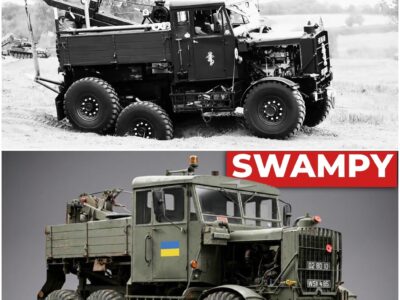
It sits on four enormous tires, squat, box-shaped, a cab made of wood framing clad in steel sheets, a flat cargo bed with bench seats down the sides. At the front, a rounded nose. At the rear, a heavy-duty hook and a steel winch drum wound with 250 ft of cable. It looked like a delivery truck.
It looked like something that belonged on a building site. It looked completely, utterly wrong for war. But over the next 6 years, vehicles exactly like this one would haul the heaviest British guns from the Western Desert to the Rhine. They would serve in North Africa, Sicily, Italy, Normandy, and the Dutch polders.
They would carry the commanders who directed entire armies. One variant would destroy German Panzer III tanks in the Tunisian Desert. Two more would be captured by Rommel himself, who thought so highly of them that he used them as his personal headquarters for the rest of the entire North African campaign.
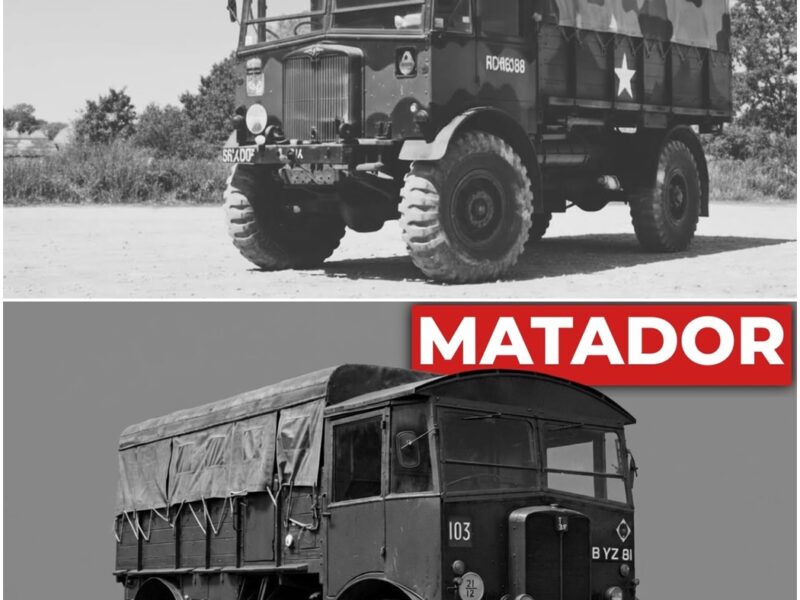
Its designation was the AEC Matador 853, and it was the most important British military vehicle most people have never heard of. To understand why the Matador existed, you need to understand the problem Britain faced in the late 1930s. Britain was rearming. The army needed medium artillery regiments capable of fielding the BL 5.
5 in medium gun and the brutal QF 3.7 in heavy anti-aircraft gun. Each of these weapons weighed between 6 and 9 tons on its traveling carriage. No standard British military truck could tow them across rough ground. The light Morris C8 quad handled the 25-pounder. The massive Scammell Pioneer handled the heavier siege pieces.
Between them was a gap large enough to lose an entire category of artillery. The answer came from a bus company. The Associated Equipment Company had been building London’s motor omnibuses since 1909, when the London General Omnibus Company first separated its manufacturing arm and gave it independent life.
AEC moved to Southall in 1926, occupying a 59-acre site purchased for 25,000 lb from the Earl of Jersey. From that factory came the buses that carried Londoners to work every morning. What most Londoners did not know was that AEC had also produced over 10,000 lorries for the War Department in the First World War using moving track assembly methods borrowed from American industry. The company understood volume.
It understood reliability. And in 1932, it had absorbed a specialist four-wheel drive firm called Hardy Motors, whose chief engineer, Captain Charles Cleaver, brought with him the expertise in 4×4 drive trains that would make the Matador possible. A prototype with a petrol engine appeared in 1937.
The War Office placed an initial order for 200 vehicles, but insisted on diesel power. The first diesel prototype was delivered on the 9th of January, 1939. The first production vehicle followed in November of the same year. The engine was an AEC A173, a six-cylinder diesel displacing 7,581 cubic centimeters, producing 95 horsepower at 1,780 revolutions per minute.
This was not a powerful engine by any measure. What it was was frugal. At approximately 9 miles per gallon from a 40-gallon tank, the Matador had a range of roughly 360 miles. The German Sd.Kfz. 7 half-track, its closest equivalent, managed barely 155 miles on petrol before needing fuel again.
The American M4 high-speed tractor burned fuel at a rate that made range planning a tactical problem. And the Matador simply did not have this problem. Its crews could drive from El Alamein to Tripoli and worry more about the road than the tank. Power drove through a four-speed gearbox and two-speed transfer case, giving eight forward ratios and permanent four-wheel drive.
Top road speed was approximately 36 mph unladen. The cab was built from an ash wood frame clad in pressed steel panels. This was a deliberate choice driven by wartime steel conservation, not engineering poverty. The wooden frame made repair straightforward anywhere a carpenter could be found. Later production versions from 1942 onward received a double roof with a circular hatch on the left side, which crews could use for observation or, if pressed, a light machine gun mount.
The rear cargo bed carried up to 10 gun crew members on transverse bench seats with narrow side doors. The floor had built-in rollers for shifting ammunition, but the feature that made the Matador legendary was its Turner winch at the rear, 7 tons of pulling capacity, 250 ft of steel wire driven from the transfer case.
In the desert, in the mud of northern Italy, in the flooded polders of the Netherlands, this winch hauled bogged guns, stuck tanks, and stranded vehicles out of situations that would have abandoned them entirely. It was the winch that turned a gun tractor into a universal rescue vehicle. The Matador was designed to tow the BL 5.
5 in medium gun at approximately 6,190 kg traveling weight, the older BL 4.5 in gun on the same carriage, and the QF 3.7 in heavy anti-aircraft gun at 9,317 kg. 786 out of the total production were built specifically as heavy anti-aircraft tractors, dedicated to towing the 3.7 in along with the associated radar and height-finding equipment.
Total production reached approximately 9,600 vehicles before the line closed. Before we get into where this thing actually fought and what it actually did under fire, if you are enjoying this deep dive into British wartime engineering, hit subscribe. It takes a second, costs nothing, and helps the channel keep producing this kind of content.
The Matador’s first combat came in France and Norway in 1940. All were early petrol-engined examples served with the British Expeditionary Force. When both campaigns collapsed, abandoned Matadors fell into German hands. The Wehrmacht, recognizing quality, pressed them into service without hesitation. This was the first indication that the vehicle Britain’s army had ordered from a bus company was something exceptional.
Diesel-engined Matadors began arriving in the Western Desert from 1941. By the Second Battle of El Alamein in October 1942, they were towing 5.5 in guns for British and Free French batteries across 30th Corps’s entire front. Desert crews loved them. In the extreme heat, they routinely removed the cab roof entirely for ventilation and visibility.
The 4×4 drivetrain and the generous low-pressure tires handled soft sand better than most observers expected from a wheeled vehicle. When shortages of Diamond T980 tank transporters struck in 1941, Matadors were improvised as tank transporters, towing the Rogers trailer at weights that far exceeded their design parameters. They did it anyway.
The 69th Medium Regiment, Royal Artillery, operating near the Libya-Tunisia border in February 1943, towed 4.5 in guns through terrain that had stopped lighter vehicles entirely. Then the chassis became something else entirely. By 1942, the British Army in North Africa was desperate for mobile anti-tank firepower that could keep up with armored formations across open desert.
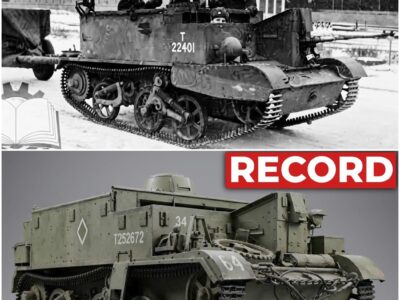
The solution, hurried and improvised as it was, came from mounting a QF 6-pounder anti-tank gun on a turntable bolted to a modified Matador chassis, enclosed in an armored box superstructure. The result was the Carrier 6-pounder gun AEC Mark I. The troops called it the Deacon, following the ecclesiastical convention that had named its predecessors Bishop and Priest.
175 Deacons were built between December 1942 and January 1943. The 6-pounder could penetrate 94 mm of armor at 100 m, which was sufficient against any German tank then operating in North Africa. The gun sat on a turntable, giving approximately 300° of traverse. Frontal armor was 20 mm. The crew of five carried 24 rounds.
The weight penalty dropped road speed to 19 mph and halved the range. But in the flat open terrain of the Tunisian Desert, where engagements played out at long range, these limitations were manageable. At the Battle of El Hamma in late March 1943, during Operation Supercharge II against the Axis Mareth Line, the 76th Royal Welsh Fusiliers Anti-Tank Regiment, Royal Artillery, used its Deacons to repel a tank counterattack by the 21st Panzer Division.
Deacons engaged and destroyed Panzer III tanks at combat range. It was a clear British success, and the only time the vehicle, rushed and imperfect as it was, performed exactly the role its designers had intended. The Deacon was always a stopgap. Its excessive height made it visible from a great distance.
Its open top left the crew exposed to artillery and air attack. The wheeled chassis would have been useless in the mud of Italy or Normandy. It was withdrawn from front-line service by mid-1943, replaced by the M10 Wolverine and later the Archer. Some surviving Deacons were converted to armored ammunition carriers and served with the 21st Army Group in Northwest Europe.
Others were exported to Turkey. But the most consequential vehicle the Matador chassis ever produced was not a gun platform. It was a rolling office. The AEC Armored Command Vehicle, universally nicknamed the Dorchester after London’s luxury hotel, was purpose-built for senior commanders. Britain was the only nation during World War II to develop and widely deploy armored command vehicles of this type.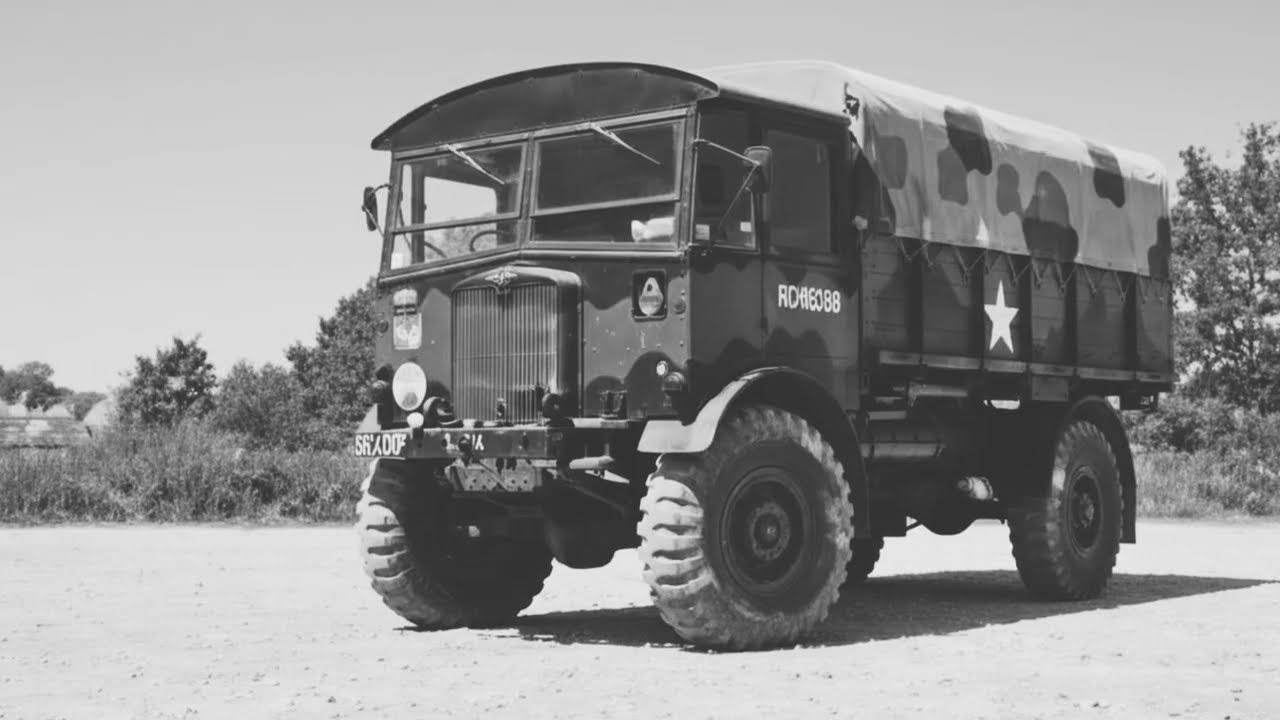
416 4×4 versions were built from 1941 onward. Inside sat folding map tables, wireless sets, seating that converted to bunks, storage for maps and manuals and typewriters. A distinctive elongated snout on the front of the vehicle was deliberately designed to make these high-value command vehicles resemble ordinary Matador gun tractors from a distance.
Field Marshal Bernard Montgomery used Dorchesters throughout the Eighth Army’s campaigns. His tactical headquarters operated one from El Alamein across North Africa, through Sicily, and into Northwest Europe. But the most dramatic Dorchester story belongs to the enemy. On the night of the 6th and 7th of April, 1941, during Rommel’s lightning advance toward Tobruk, three Dorchesters of the Western Desert Force became lost near El Mechili in darkness and blundered into a German reconnaissance unit. The vehicles belonged to Lieutenant General Sir Richard O’Connor and Major General Michael Gambier-Parry, commander of the Second Armored Division. Both generals were captured. The Dorchesters were taken intact. Rommel was delighted. He nicknamed the captured vehicles Mammoth, the German word for mammoth, for their tall profile, and immediately appropriated two as his personal headquarters. He named them Max and Moritz after characters in a beloved German children’s story. Modified with German diesel engines and marked with Africa Corps insignia, Max and Moritz served Rommel’s command throughout the
entire North African campaign. The most important British mobile headquarters in the desert were SS for 2 years, being operated by the man they were supposed to be fighting. They were finally found abandoned at Cap Bon, Tunisia, in May 1943 following the Axis surrender. Corporal Victor Berry drove a Dorchester for the 8th Army Tactical Headquarters from El Alamein across North Africa, through Sicily, up the length of mainland Italy, and into Austria.
The total distance was over 11,000 mi. During that journey, the vehicle broke down exactly once. In Normandy, from June 1944, Matadors served throughout the 21st Army Group’s artillery operations. A Matador nicknamed Gazala, towing a 5.5-in gun, was photographed passing through a Norman village on the 1st of July 1944.
The 64th Medium Regiment, Royal Artillery, operated 4.5-in guns through the Akan operations. 15 Matadors were assigned to each Churchill Crocodile flamethrower battalion of the 79th Armoured Division, towing the crocodile fuel trailers when the flamethrower tanks were transported by road. One late-war photograph shows a British Matador towing a captured German 88-mm gun through a German town.
Another shows Dutch civilians washing a Matador in a village stream on the 25th of November 1944. A small human detail in a very large war. On paper, the German Sd.Kfz. 7 appeared superior, 140 horsepower against the Matador’s 95, track-driven, capable of crossing terrain that would stop any wheeled vehicle, carrying 12 men against the Matador’s 10.
It was undeniably more capable across the mud of the Eastern Front, but the Sd.Kfz. 7 required complex track maintenance that demanded specialist mechanics and constant attention. Its 3.45-ton winch was half the capacity of the Matador’s 7-ton unit. Its petrol engine gave a range of under 160 mi. Its tracked drive components were vulnerable to breakdown in ways that the Matador’s simple axles and differentials were not.
The American M4 High-Speed Tractor offered genuine tracked performance and 210 horsepower, but consumed fuel at a rate that made it logistically expensive to operate at the distances the British Army routinely covered in the desert and in the pursuit across France. As Britain chose wheeled simplicity over tracked capability, and across its actual theaters of operation, that choice was consistently justified.
After 1945, the Matador refused to stop. The British Army ordered 200 additional vehicles in 1950 and 51, fitted with an upgraded 105-horsepower engine as a stopgap while intended replacement tractors proved slow to arrive. The Royal Air Force ordered nearly 1,000 around the same period.
Individual Matadors remained in military service into the 1960s. Some served into the early 1970s. Surplus Matadors then found an extraordinary second career in civilian life. Thousands had timber cranes fitted and went to work in British forests, where the 4×4 capability, low gearing, and winch made them ideal logging vehicles.
Bus companies completed the irony of their origins. Birmingham City Transport, Southern Vectis, Bradford City Transport, and London Transport all operated Matador breakdown trucks, recovering the very type of vehicle their builder had been founded to serve. Billy Smart’s Circus ran one. The fairground and traveling showman community adopted them as heavy haulers for a generation.
Today, hundreds of Matadors survive in preservation. The Imperial War Museum at Duxford displays one in desert camouflage towing a 4.5-in gun. Corporal Berry’s Dorchester sits at the Royal Signals Corps Museum in Blandford Forum. The Whittle Transport Museum near Birmingham holds a former Dorchester converted by Birmingham City Transport into a breakdown recovery vehicle.
Running examples appear annually at the AEC Rally at Newark. Airfix has kept the Matador in the public imagination since 1966 with a model kit of the Matador and 5.5-in gun, reissued as a Vintage Classics Edition in 2018. 1939, Southall, Middlesex. A wooden cab clad in steel, four enormous tires, a 7-ton winch, and a sign on the factory gate that reads “Builders of London’s buses for 50 years.” It was underpowered.
It was slow. Its cab was built from wood. It had no armor to speak of. It could not cross a muddy field in northern France without chains on the tires. On paper, the German half-track was its superior in almost every measurable category, and yet it worked. It worked in the Libyan desert at 40°.
Us with a cab roof stripped off and a crew who had not seen fresh water in 3 days. It worked in the rain and clay of Normandy, hauling 5.5-in guns into firing positions for the barrages that opened the road to Germany. It worked as a command vehicle for the general who won North Africa and as a captured prize for the general who lost it.
It worked in the forests of Wales 30 years after the war ended, dragging timber down tracks that defeated modern vehicles. The company that built London’s buses built the machine that kept Britain’s guns moving. That is not coincidence. That is British industrial pragmatism. That is the Matador.