Why This ‘Primitive’ British Truck Hauled Ammunition When Every Horse Died In The Heat D
November 1915, the Tigris River, 150 miles south of Baghdad, a British supply column is moving north through the desert. Horses strain against their harnesses in heat that has climbed past 120° Fahrenheit. Mules collapse at the roadside and are left where they fall. There are no roads.
There is no shade for 200 miles in any direction. The ground beneath the column’s wheels and hooves bakes like fired clay in summer and turns to impossible mud when the rains arrive. The column carries ammunition for General Townshend’s 6th Indian Division advancing on Baghdad without adequate supply, without enough water, and without the vehicles to sustain it.
The result would become the worst military disaster in British history since the American War of Independence. 13,000 soldiers would surrender at Kut. Nearly 5,000 of them would die in Ottoman captivity. A parliamentary commission would condemn the entire operation. A Secretary of State would resign. A commanding general would take his own life.
And in the ashes of that catastrophe, Britain would build a machine designed to make certain it never happened again. Its name was the Thornycroft Hathi. In Hindi, the word means elephant, and it was the first true purpose-built four-wheel drive military vehicle Britain ever produced.
To understand why the Hathi existed, you need to understand what Mesopotamia did to British military thinking between 1914 and 1918. The British entered Mesopotamia in November 1914 with 4,700 soldiers and a supply chain designed for the short colonial campaigns of the Indian frontier. What they found was something entirely different.
The theater stretched nearly 800 river miles from the Persian Gulf to Mosul. Summer temperatures hit 120° Fahrenheit in the shade. Winter brought rains that turned the desert floor into a swamp that swallowed carts, guns, and animals whole. There were virtually no roads in the entire theater. There was no infrastructure.
There was almost nothing. The army that marched north from Basra moved on four legs and oars. River steamers carried the bulk of supplies upstream against currents running at 6 miles per hour. Animal transport provided the final link to the front line. Mules, horses, camels, and bullocks consumed vast quantities of the very fodder they were carrying northward.
Every mile of advance reduced the net supply delivered. When the summer came, the animals died from heat, dehydration, and disease at rates that destroyed entire transport columns. When the rains came, they sank into ground that offered no traction and no footing. General Townshend’s mechanized transport at the Battle of Ctesiphon in November 1915 consisted of two armored cars, two lorries, and one motor ambulance.
That was the total. Everything else was animal-drawn or man-carried. He advanced anyway, too fast, too far, without the supply line to sustain a force of that size at that distance from its base. His army was broken at Ctesiphon and retreated to the town of Kut where 13,000 soldiers endured a siege of 147 days. Four relief attempts failed.
The garrison surrendered on 29 April 1916. The Mesopotamia Commission reported in 1917. It was one of the most damning official documents in British military history. The operations had been conducted, in the words of Field Marshal Sir William Robertson, without proper regard for the vital questions of supply and maintenance.
Generals were condemned by name. Secretary of State for India Austen Chamberlain resigned from cabinet. And the army was forced to ask a question it had never seriously answered. What kind of vehicle does a desert campaign actually require? Under General Maude, the transformation came. 300 Ford lorries carried British infantry on the flanking march that captured Khan Baghdadi in March 1918.
The motorized transport force that numbered two lorries in 1915 numbered 7,000 vehicles by the armistice. But those vehicles were still improvised, still adapted from commercial road designs, still struggling on terrain that had not been designed into them from the beginning. They worked because there were enough of them, not because they were right.
The army needed something built from the ground up for desert sand, river mud, and extreme heat. It needed a machine that could haul 10 tons up a slope that would stop a horse cold, cross gullies with vertical banks 3 feet high, and keep moving when every road had ceased to exist. It needed a machine that did not eat its own cargo or die when the temperature passed 100°.
In 1922, engineers at the Royal Army Service Corps Experimental Department at Aldershot began work on that machine. They cannibalized components from a captured German Ehrhardt artillery tractor. They applied every lesson that Mesopotamia’s dead had paid to teach. They called it the Hathi. Now, before we get into where this machine went and what it proved, if you are enjoying this deep dive into British military engineering, hit subscribe.
It takes a second. It costs nothing. And it helps the channel keep going. The Hathi was built at Thornycroft’s factory on Worting Road, Basingstoke, Hampshire in 1924. 25 vehicles were produced. That number sounds small, but what those 25 machines represented was enormous. The engine was a Thornycroft straight-six displacing 11.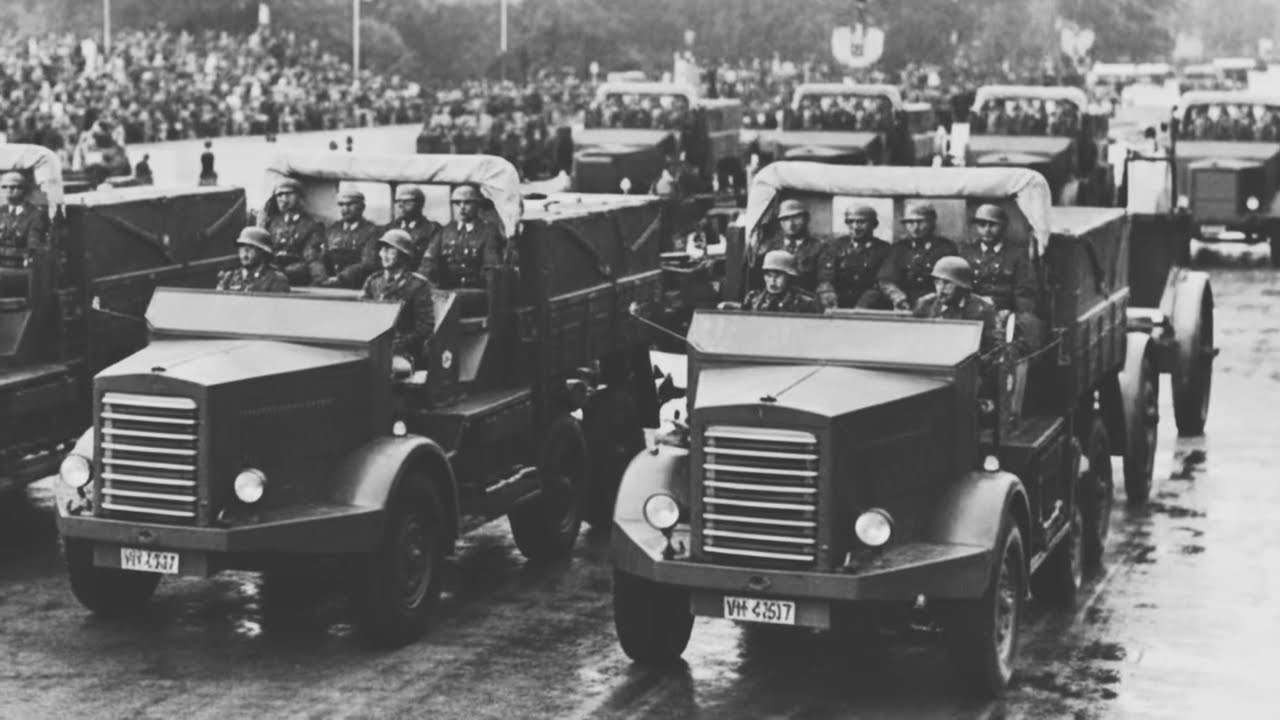
3 liters and producing 100 brake horsepower. In 1924, 100 brake horsepower in a military vehicle was exceptional. The engine used dry sump lubrication specifically engineered to prevent oil starvation when the vehicle tilted sharply on rough ground. Components, including axle casings and the radiator surround, were cast in aluminum to reduce overall weight, a remarkably advanced decision for the era.
The drivetrain was the Hathi’s defining achievement. Full four-wheel drive delivered power to all corners through a shaft and bevel gear system of considerable complexity. Because constant velocity joints had not yet been invented, Thornycroft engineers devised fixed shafts running inside axle casings driving vertical shafts through the steering kingpins via bevel gears.
It demanded skilled maintenance. It worked absolutely in conditions that stopped every rival. Ground clearance was 20 inches. The rear winch was rated at 5 tons. The vehicle could haul a 10-ton trailer up a 1 in 10 gradient at 7 miles per hour. It could climb a 1 in 4 slope towing 5 tons.
It could cross a gully with vertical walls 3 feet high. It could move through soft sand that swallowed conventional trucks to their axles. The War Office’s October 1923 specification had demanded an average sustained road speed of 22 miles per hour and a steady drawbar pull of 9,000 lb. The Hathi met both.
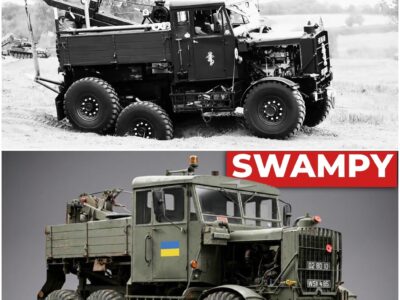
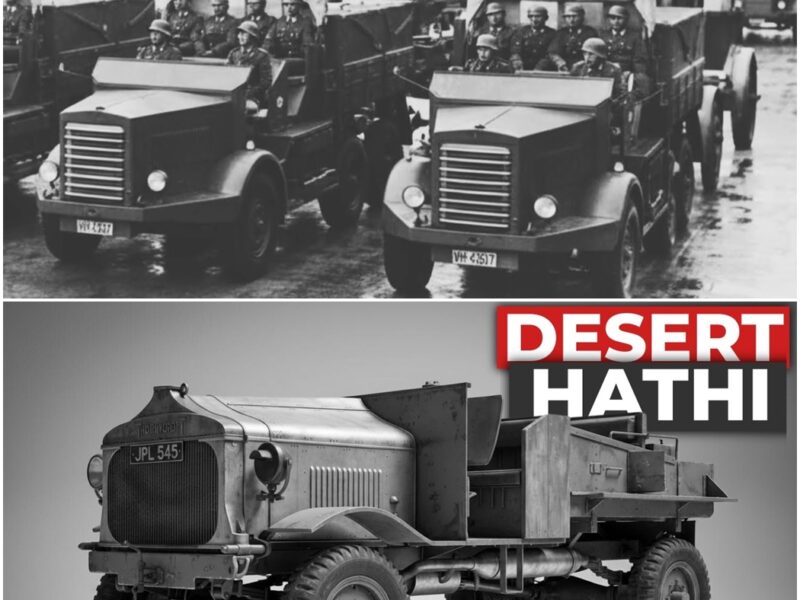
The appearance of the machine was, to put it fairly, industrial. The bonnet was extraordinarily wide, concave at the top, dominating the entire front third of the vehicle. Spare wheels mounted high on each side of the rear body. The cab was open, bench-seated with no windscreen and only a folding canvas roof for weather.
No armor, no comfort, no concession to appearance whatsoever. It looked exactly like its name. It looked like a mechanical elephant. To critics who saw it for the first time on the Aldershot ranges, it looked absurd. It looked primitive. It looked like a machine assembled by engineers who had never seen a modern truck.
Those critics had not spent 1915 on the Tigris. The design had been led by the Royal Army Service Corps Experimental Department under Honorary Colonel Herbert Niblett, Sir John Isaac Thornycroft’s son-in-law. The production contract went to Basingstoke because Thornycroft had the factory, the engineers, and the institutional knowledge of military vehicle production that no other British manufacturer could match.
The prototype was test-driven across a replica trench simulating the Basingstoke Canal by Mechanist Sergeant Major Taylor of the Experimental Department. Photographs of that crossing survive in the Imperial War Museum collection. Taylor’s expression in every photograph is that of a man who already knows the machine works and is mildly irritated by being asked to prove it again.
In 1925, eight Hathis shipped to Australia. Inspector General Harry Chauvel, who had commanded the Desert Mounted Corps in Palestine and understood better than most what machines could do in arid terrain, examined them and declared that with their arrival, mechanization had been achieved.
Those eight vehicles served in northern Australia through the 1930s and remained in reserve as late as 1945, 21 years after they left Basingstoke. At least one example went to Sudan in 1926. Deployed in a theater where the heat and the sand replicated precisely the conditions that had destroyed British logistics in Mesopotamia a decade before.
At home, the Hathis served with the Royal Field Artillery towing 3-in anti-aircraft guns on exercises across Salisbury Plain. A breakdown recovery variant was built in 1926 with a fixed jib and hand-operated winch for field repairs. The Royal Navy received examples for Portsmouth Dockyard. The Royal Air Force took others.
A six-wheel experimental version with a redesigned chassis was tested in May 1928. A Royal Marines half-track conversion using roadless tracks was evaluated separately. Every variant was an attempt to push the Hathi’s core philosophy further, to find the limit of what purpose-built four-wheel drive military engineering could accomplish.
The rivals of the era tell the story of how far ahead the Hathi was and why it could not last. The American FWD Model B was the only mass-produced four-wheel drive truck of the World War with 17,555 built. Its engine produced 36 horsepower against the Hathi’s 100. The Mack Bulldog, the era’s finest heavy hauler, produced 74 horsepower and sold in tens of thousands. But it was a road vehicle.
It could not cross soft sand. It could not climb a 1 in 4 gradient towing 5 tons. The French Berliet that had sustained Verdun’s supply line was equally capable on roads and equally helpless off them. Against any conventional rival, the Hathi’s off-road performance was in a different category entirely.
But the Hathi’s bevel gear front axle drive mechanism demanded maintenance expertise that most units simply did not have. Without constant velocity joints, the system was inherently fragile under heavy sustained use. 6×4 trucks using the War Department’s rear bogie suspension offered comparable off-road performance at a fraction of the mechanical complexity.
Built on commercial chassis that mechanics already understood, half-tracks proved more practical across the widest range of terrain. By the late 1920s, the Hathi’s moment had passed. Thornycroft did not stop. The company built six-wheelers and eight-wheelers through the 1930s. It built the Nubian 4×4 and the Tartar 6×4 for the Second War, producing several thousand of each.
It built the mighty Antar, the heavy tank transporter of the Cold War, which could haul a Centurion across a waterlogged German field and still make schedule. A single Hathi survives today, held in the reserve collection of the Royal Electrical and Mechanical Engineers Museum at Lyneham, Wiltshire.
It is a naval example from Portsmouth Dockyard. It is not on regular public display. It sits in storage, in the dark, exactly as forgotten as the campaign that made it necessary. Return to November 1915. The Tigris River, 150 mi south of Baghdad. The horses are dying in the heat. The lorries number two.
13,000 soldiers are marching into a siege that will kill thousands of them, and Britain is learning at catastrophic cost that no army can sustain a campaign across 400 mi of desert on four legs and river current alone. The Hathi came too late for Mesopotamia. It was slow, complex, and produced in quantities too small to matter on its own.
It was superseded within a decade by simpler designs. All of that is true, and yet it worked in the desert stations of northern Australia, in the colonial heat of Sudan, on the artillery ranges of Aldershot, in the dockyards of Portsmouth. It worked because it was built on an exact understanding of failure. Every specification, every gear ratio, every aluminum casting, every inch of ground clearance came from what Mesopotamia had cost.
The greatest lesson Britain ever received in military logistics carried a price of nearly 39,000 dead and one of the most damning official inquiries ever published. It taught one thing with absolute clarity. You cannot fight a desert campaign on four legs. The Hathi was the answer, written in steel and four-wheel drive at Basingstoke. That is not coincidence.
That is British military engineering learning the