The ‘Tiny’ Japanese Wheeled Tank That Made China Rethink Every Island Invasion D
November 2022. Yonaguni Airport, Okinawa Prefecture, the westernmost point of Japanese territory, 110 km from the coast of Taiwan. A Kawasaki C-2 transport aircraft touches down on a runway barely long enough to receive it. And its rear cargo ramp drops open into the Pacific wind.
What rolls out makes no sense. It is an eight-wheeled armored vehicle painted in woodland camouflage carrying a 105-mm rifled cannon in a fully enclosed turret. It weighs 26 tons. It is almost 8 and 1/2 m long. It has the firepower of a Cold War main battle tank mounted on rubber tires instead of steel tracks, driven by a crew of four, and it has just been flown 600 km from the Japanese mainland in under 2 hours.
It looks like a mistake, a weapon system designed by a committee that could not decide whether it wanted a tank or a truck, and somehow ended up with both. It has no meaningful armor against modern anti-tank weapons. It cannot swim. It has no air conditioning. Its main gun is loaded by hand. On paper, it is outgunned by every main battle tank in the Asia-Pacific, out-armored by every infantry fighting vehicle in Chinese service, and out-ranged by every anti-ship missile pointed at the island chain it was built to defend. And yet this single vehicle represents the most dramatic shift in Japanese defense strategy since the end of the Second World War. It would go on to equip rapid deployment regiments across the Japanese Ground Self-Defense Force, become the centerpiece of an entirely new doctrine built around defending over a thousand islands stretched across 1,400 km of open ocean. And in 2026, it would be deployed overseas to the Philippines marking the first time a Japanese armored fighting vehicle had operated on
foreign soil since 1945. Its designation is the Type 16 Maneuver Combat Vehicle, and it was designed to do one thing: fly to a remote island within hours and destroy an amphibious invasion before it can establish a foothold. To understand why the Type 16 exists, you need to understand the threat Japan spent 50 years preparing for and the moment it realized it had been preparing for the wrong one.
For the entire Cold War, the Japan Ground Self-Defense Force, the JGSDF, was structured around a single scenario, a Soviet amphibious and airborne assault on the northern island of Hokkaido. Japan maintained over 1,000 main battle tanks, the majority of them concentrated on Hokkaido and the northern plains of Honshu.
Heavy armor, fixed positions, deep defensive lines across predictable terrain. The Soviet Union was the enemy. Hokkaido was the battlefield and tanks were the answer. Then the Soviet Union collapsed and the threat moved south. Beginning in the late 1990s and accelerating sharply after 2008, the People’s Republic of China expanded its naval and coast guard presence around the Senkaku Islands, a chain of uninhabited islets in the East China Sea, administered by Japan but claimed by Beijing.
In September 2012, Prime Minister Yoshihiko Noda nationalized three of the Senkaku Islands by purchasing them from their private owner. The diplomatic crisis that followed never fully subsided. Chinese government vessels began entering the waters around the islands on an almost daily basis. By 2025, according to Japan Coast Guard records, Chinese ships entered the Senkaku contiguous zone on 357 out of 365 days, the highest figure since monitoring began in 2008.
They maintained an unbroken continuous presence of 335 consecutive days. And since mid-2024, all four routine Chinese patrol vessels operating in those waters have been armed with 76 mm naval guns. The problem for Japan was not simply diplomatic, it was structural. The JGSDF had spent decades building an army designed to fight on flat northern terrain with heavy tanks.
Now the threat was 1,000 km to the south, spread across the Nansei Island chain, a string of over 160 islands stretching from Kyushu to within sight of Taiwan. Most of these islands have no port capable of receiving a tank transporter. Many have no runway longer than a few hundred meters. Some have no military presence at all.
A 44-ton Type 10 main battle tank cannot be flown to a contested island in 2 hours. A 26-ton Type 16 can. The concept traces back to 2003 when Japan’s Technical Research and Development Institute launched the Future Combat Vehicle Program, an ambitious attempt to build a universal wheeled chassis capable of mounting everything from a 40-mm cannon to a 155-mm howitzer.
The program was canceled on cost grounds, but the core idea survived. A wheeled combat vehicle light enough to fit inside a C-2 transport aircraft, fast enough to deploy from mainland air bases to remote island air strips within hours, and armed with a gun powerful enough to destroy anything that comes ashore from a landing craft.
Development was led by the Technical Research and Development Institute, known as TRDI, with Mitsubishi Heavy Industries selected as the manufacturer. The choice of Mitsubishi over Komatsu, Japan’s traditional wheeled vehicle builder, was deliberate. Mitsubishi built Japan’s tanks. They understood turrets, recoil management, and fire control systems.
The first prototype was completed in 2008. Four testing phases followed over the next 7 years. The vehicle was publicly unveiled on October 9th, 2013, and formally adopted into service in fiscal year 2016 under the watch of General Kiyofumi Iwata, the 34th Chief of Staff of the JGSDF, and a career armor officer who had commanded the 7th Armor Division on Hokkaido before overseeing the very pivot away from the heavy tank force he had spent his career leading.
The vehicle itself is a study in calculated compromise. The hull is an 8×8 wheeled configuration with the engine mounted front left and the driver seated front right. Power comes from a Mitsubishi four-cylinder turbocharged diesel producing between 507 and 570 brake horsepower, depending on the source.
The exact figure is disputed. What is not disputed is the result, a top speed of 100 km/h on paved roads, 60 km/h cross country, and a maximum range of approximately 400 km without refueling. The transmission is automatic. The front four wheels steer. All eight are driven through a central drive shaft and differential system.
Fitted with run-flat tires and a central tire inflation system, the suspension is hydropneumatic, giving the crew the ability to adjust ride height for different terrain. The main armament is a 105 mm L52 rifled gun, developed and manufactured by Japan Steel Works. It is derived from the same Royal Ordnance L7 gun family that armed NATO tanks for decades, but it is not a copy.
The barrel is one caliber longer than the gun on the retired Type 74 tank. It incorporates a unique spiral bored muzzle brake, an integrated thermal sleeve, and a fume extractor. More importantly, the fire control and recoil suppression systems are drawn directly from the Type 10 main battle tank development program.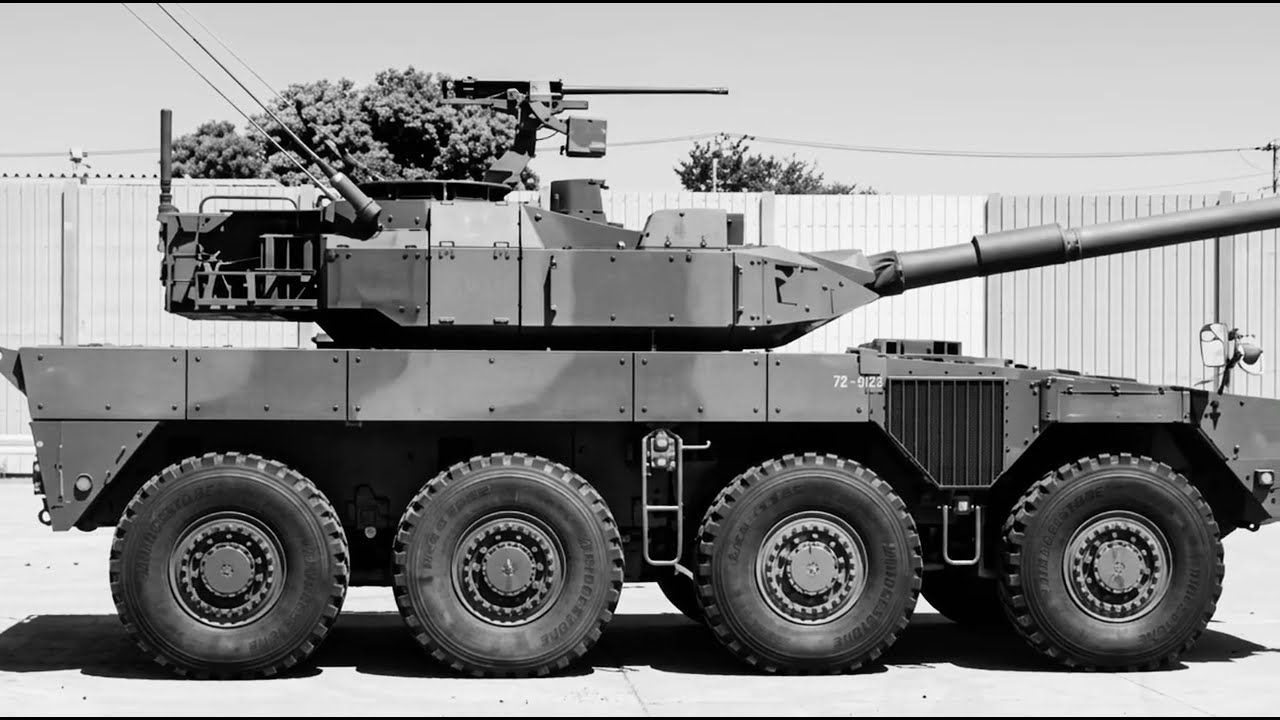
This means a wheeled vehicle weighing 26 tons can fire its main gun accurately while moving at speed, engage targets on the flank during high-speed maneuver, and even fire while changing direction. The gun is manually loaded by the fourth crew member. Approximately 40 rounds of NATO standard ammunition are carried, including armor-piercing fin stabilized discarding sabot, high explosive anti-tank multi-purpose, and high explosive squash head.
Reload time is estimated between 4 and 5 and 1/2 seconds. Secondary armament includes a roof-mounted 12.7 mm M2 Browning heavy machine gun and a coaxial 7.62 mm Type 74 machine gun. The electronic suite includes a digital fire control system, laser rangefinder, ballistic computer, meteorological sensor, third-generation thermal imaging sights, and a laser warning receiver.
The vehicle is networked into the JGSDF’s C4I command system, allowing it to receive target data from other platforms in real time. Armor protection is where the compromise becomes most obvious. The hull is welded multi-layer steel, modular in concept and similar in philosophy to the Type 10 tank, but dramatically thinner.
Base protection is rated to resist small arms fire only, roughly equivalent to STANAG 4569 level 3. The frontal arc is designed to withstand 20 to 30 mm auto cannon rounds. The sides can stop 14.5 mm heavy machine gun fire. An optional undercarriage plate provides limited protection against mines and improvised explosive devices.
During testing in 2009, the frontal armor was subjected to a Carl Gustaf M2 recoilless rifle round to evaluate its resistance to shaped charge warheads. There is no active protection system. There is no air conditioning. The loader works in a cramped turret in a vehicle designed to operate on subtropical islands where summer temperatures regularly exceed 35° C.
These are not oversights. They are weight savings. Every kilogram removed is a kilogram that keeps the Type 16 light enough to fly. Now, before we get into where this vehicle is actually deployed and what it means for the future of Pacific defense, if you are enjoying this deep dive into Japanese military engineering, hit subscribe.
It costs nothing, takes a second, and helps the channel grow. The Type 16 has never fired a shot in combat. No one has. Japan has not fought a war since 1945, but the vehicle’s operational record is not measured in kills. It is measured in speed, presence, and the message it sends. The first major public demonstration came during exercise Keen Sword in November 2022, a bilateral exercise between the Japan Self-Defense Forces and the United States military.
For the first time, a Type 16 was airlifted by C-2 to Yonaguni, Japan’s westernmost inhabited island. It rolled off the aircraft, drove on public roads through the island’s single town, and conducted maneuver drills within hours of departure from mainland Japan. The significance was not tactical, it was strategic.
Yonaguni sits 110 km from Taiwan and approximately 170 km from the Senkaku Islands. A vehicle that can reach Yonaguni by air in under 2 hours can reach any airstrip in the Nansei chain before an adversary can consolidate a beachhead. The Type 16 now equips five rapid deployment regiments across the JGSDF, including the 15th Rapid Deployment Regiment under the 14th Brigade at Zentsuji and the 42nd Rapid Deployment Regiment under the 8th Division at Kumamoto.
Companies are organized into 13 vehicles, one headquarters vehicle and three platoons of four. Crews are drawn from the armor branch and trained extensively in shoot and scoot tactics using the vehicle’s speed and fire on the move capability to engage targets and displace before return fire arrives. The doctrine is not to hold ground, it is to deny a beachhead.
The island defense posture extends far beyond the Type 16 itself. The JGSDF has established new garrisons on Yonaguni, Amami Oshima, Miyako, and Ishigaki, all islands in the Nansei chain. In 2018, the Amphibious Rapid Deployment Brigade, the ARDB, was stood up at Sasebo, Japan’s first marine-style amphibious force since the Second World War, tasked specifically with retaking islands that have been occupied by an adversary.
The Type 16 is the fire support asset designed to work alongside the ARDB, arriving by air to reinforce island garrisons while heavier forces are moved by sea. In March 2025, the Type 16 participated in Exercise Dharma Guardian alongside the Indian Army, expanding its operational footprint beyond the Pacific.
But the truly historic moment came in April 2026 when the Type 16 deployed overseas for the first time in its history. During Exercise Balikatan 2026 in the Philippines, running from April 20 to May 8, the JGSDF conducted its first ever ground participation in the annual US-Philippine military exercise. Type 16 crews conducted live fire and maneuver drills under tropical conditions alongside Philippine Army units.
According to Philippine defense reporting, personnel from the Philippine Army armor division evaluated the Type 16 during those exercises, assessing its stabilization system, thermal management under tropical heat, suspension performance, and crew workload. The Philippines is now reportedly weighing a purchase, which would make it the first foreign buyer of a Japanese armored fighting vehicle since the country’s post-war arms export ban was effectively lifted under Prime Minister Shinzo Abe’s 2014 revision of the three principles on defense equipment transfer. On paper, the Type 16’s closest rival is the Italian Centauro. The comparison is almost inevitable. Both are 8×8 wheeled platforms mounting a 105-mm rifled gun. The Centauro entered service in 1991, weighs approximately 24 to 25 tons, and has been combat-proven in Somalia, the Balkans, and Lebanon. Over 400 were built. Its successor, the Centauro II, mounts a 120-mm gun. The Centauro has
decades of operational experience the Type 16 lacks. What the Type 16 offers in return is a generation of advancement in electronics, networking, and fire control. Its ability to engage targets accurately while moving at speed, fed by real-time targeting data through the C4I network, represents a fundamentally different approach to the same concept.
The French offer an alternative philosophy entirely. The AMX-10RC, a 6×6 reconnaissance vehicle with a 105-mm medium-pressure gun, saw extensive combat in the Gulf War, Afghanistan, and Mali. France donated examples to Ukraine. But its successor, the EBRC Jaguar, abandons the big gun altogether in favor of a 40-mm case telescoped ammunition cannon and medium-range anti-tank missiles.
The French concluded that missiles are the future of wheeled fire support. Japan concluded that a rifled cannon still has a role, particularly in the first critical hours of an island defense scenario, where a gun can engage multiple targets faster than a missile system can reload. The adversary the Type 16 is most likely to face is the Chinese ZTL 11, also known as the Type 11 assault vehicle.
It is an 8×8 platform of similar weight mounting a 105 mm gun capable of firing gun-launched anti-tank guided missiles. It carries millimeter wave radar, and critically, it is fully amphibious. The ZTL 11 can swim ashore from a landing ship under its own power using water jets. The Type 16 cannot enter water deeper than approximately 1 m.
In a direct confrontation on a contested beach, the ZTL 11 arrives by sea. The Type 16 arrives by air. The question is which one gets there first. The most instructive comparison, however, is with a vehicle that no longer exists. The American Stryker M1128 Mobile Gun System mounted the same caliber weapon, a 105 mm gun, on an 8×8 Stryker chassis with an autoloader and a crew of three.
142 were built. Three were lost in combat. On May 12th, 2021, the United States Army announced it would divest all Mobile Gun Systems by the end of fiscal year 2022, citing obsolescence and systemic issues with the vehicle’s dated cannon and automatic loader. The autoloader was the critical failure point. Maintenance was excessive.
Reliability was poor. The Type 16’s decision to use a manual loader, which critics called primitive and exhausting, was vindicated by the death of its American counterpart. Japan chose human hands over mechanical complexity, and the vehicle it built is still in production, while the Stryker Gun System sits in a boneyard.
The Acquisition, Technology, and Logistics Agency announced on March 15, 2023 that a total of 250 Type 16 vehicles would be procured. Approximately 100 have been delivered to date, with orders for 150 more expected. Unit cost is roughly 700 million yen, equivalent to approximately 5 to 6 and 1/2 million dollars.
The Type 16’s chassis has already spawned an entire family of vehicles, the common tactical wheeled vehicle program. The Type 24 wheeled armored combat vehicle mounts a 30 mm cannon as an infantry fighting vehicle. The Type 24 wheeled 120 mm mobile mortar provides indirect fire support on the same hull.
A reconnaissance combat variant is under development. The platform is no longer a single vehicle. It is the foundation of Japan’s future wheeled force. November 2022, Yonaguni Airport. An eight-wheeled vehicle rolls off the ramp of a transport aircraft and onto the tarmac of an island that most Japanese citizens could not find on a map.
It carries a gun designed to kill amphibious assault vehicles. It is too lightly armored to survive a direct hit from a modern tank. It has no ability to swim. It has no air conditioning for crews operating in subtropical heat. Its main gun is loaded by hand in a turret that was deliberately kept small to save weight, and none of that matters because the Type 16 was never designed to win a tank battle.
It was designed to be there, on the runway. With a 105 mm cannon pointed at the beach before the landing craft have opened their doors, before the beachhead is established, before the first boot hits the sand. For 70 years, Japan built an army to defend an island that was never attacked. The Type 16 is the machine that proves they finally understand which islands actually need defending. That is not a compromise.
That is a doctrine.