T-34 Hunter: How Dangerous Was the German Puma Armored Car? D
Eight leading wheels, a revolutionary monocoque hull, and the unique ability to rush backward at the exact same speed as forward. Friends, before you is the German armored car Puma, which was designed for deep reconnaissance, but turned into a dangerous hunter capable of challenging even T-34 medium tanks.
How did a wheeled vehicle manage to surpass its tracked counterparts in off-road capability? And why did the designers suddenly defy tradition by equipping it with an atypical diesel engine? Today, we will analyze in detail the hidden capabilities of this rare wheeled tank. Be sure to watch the episode to the end.
You will find out what unexpected supply problem forced the production of this high-tech machine to be shut down after only about 100 units were built. Let’s not delay. Let’s begin. There is a certain military logic that is difficult to dispute. A tank means armor, firepower, and tracks. But tracks are also a problem.
They wear out quickly. They require constant maintenance. They limit speed. And on a good road, a tank hopelessly loses to any truck. That is why back in the 1920s, military engineers from different countries began searching for a middle ground. A machine that would combine the protection and firepower of a tank with the mobility and efficiency of wheeled vehicles.
Thus, armored cars were born. And at first, the idea worked. Three-axle vehicles with a 6×4 wheel configuration, meaning six wheels, four of which were driven, competed quite seriously with light tanks by the mid-1930s. Soviet armored cars of the BA series, BA stands for medium armored car to be precise, the BA-3 and BA-10 carried a gun in a turret, had decent armor, and cost significantly less than any tank.
Training a driver for such a vehicle was also easier and faster. But this concept had one fundamental weak point. And it revealed itself every time the vehicle drove off the road. Wheels on soft ground are not at all the same as tracks. An armored car with a 6×4 wheel configuration bogs down where a tank passes without effort.
A muddy field after rain, a sandy shoulder, a ruined dirt road, all of this could become an insurmountable obstacle. In essence, such a vehicle was tied to the road surface like a tram to its rails. It could not leave the route. Engineers understood this and they proposed what seemed to be an elegant way out.
Removable tracked chains for the rear wheels. You put them on and the armored car turns into something between a wheeled vehicle and a half-track. It was supposed to help on difficult sections. In practice, this solution created more problems than it solved. Before every difficult section, the crew had to stop and spend time installing the tracks.
After crossing it, they had to stop again and remove them. In training, this looked tolerable. In a real combat situation, every extra minute spent in an open area was a risk that nobody wanted to take. It became clear. The evolutionary path of armored cars built on commercial chassis had reached a dead end.
All the possibilities of this concept were exhausted. To move forward, it was necessary to start with a clean slate. A way out of the dead end was found. But it required creating a machine that had never existed anywhere else in the world. 1936. A machine that no one in the world had built before begins to enter German reconnaissance units.
Its official designation is Sonderkraftfahrzeug 231, the eight-wheeled variant. Translated literally from German, it means special vehicle 231. But in the troops, it was called simply the eight-wheeler. An 8×8 wheel configuration. Eight wheels and all eight are driven. This was a fundamental difference from everything that had been built before.
But, it was not just about the number of wheels. Each of the eight wheels had independent suspension. This meant that when one wheel hit an obstacle, the other seven continued to work normally. The vehicle did not tilt, did not lose traction, and did not get stuck where any three-axle armored car would.
Now, about off-road capability and specific figures. The Sonderkraftfahrzeug 231 could overcome a slope of 30°. That is approximately the angle of a fairly steep city hill. It could cross a ford up to 1 m deep. It could cross a ditch up to 2 m wide. For a wheeled vehicle of that time, these were indicators that made military engineers from other countries shake their heads.
A carburetor engine with a capacity of 150 horsepower accelerated the vehicle, which weighed just over 8 tons, to 100 km/h. The power-to-weight ratio was 18 horsepower per ton. For comparison, the figure for a medium tank of that period was lower. On the highway, the vehicle covered about 300 km on a single tank of fuel.
The armament corresponded to a light tank of that time, a 20-mm automatic gun KwK 30. The exact same one that stood on the mass-produced German light tank Panzerkampfwagen II. The frontal armor was 15 mm, the same as that tank. Along the sides, it was slightly thinner, but for a reconnaissance vehicle, this was a reasonable compromise.
The tires were a separate topic of conversation. Rubber with a self-sealing compound inside. If a tire received a bullet puncture, it did not deflate instantly. The compound inside sealed the damage. The vehicle could continue moving even after six punctures in a single wheel. But, the most unusual technical solution was the presence of two control stations.
In the front sat the primary driver. In the rear sat the second driver with his own steering wheel and pedals. Both could fully control the vehicle. And this was not an extravagance. It was a well-thought-out tactical necessity. In reconnaissance, situations can be simple.
You drive forward, run into an ambush, and need to retreat immediately. For an ordinary vehicle, this requires turning around. This takes time. This takes space for maneuvering. These are extra seconds under fire. The Sonderkraftfahrzeug 231 simply switched to reverse driving mode, and the second driver took control. The vehicle retreated rear first at the same speed it moved forward without turning around, without losing time.
The transfer case in reverse gear provided the same number of speeds in both directions. This was not just a technical detail. It changed the very tactics of reconnaissance work. It seemed things could not get more perfect. But at that very moment, designers had already begun working on a machine that would make the Sonderkraftfahrzeug 231 obsolete.
In the late 1930s, the German military formulated a technical specification for a new armored car. Formally, this was an order to replace the Sonderkraftfahrzeug 231. But when the engineers started working, it became clear that this was not about improving the existing machine. It was about a fundamentally new approach.
The first and most radical decision concerned the design of the hull. Every car of that time, both civilian and military, had a frame. A rigid steel base to which everything else was attached, the body, engine, and suspension. The frame carried the load. The body simply sat on top of it. This was familiar, understandable, and proven by decades of practice.
The new armored car received no frame. Instead, the designers used a monocoque hull. The armored plates themselves became the load-bearing structure of the machine. The hull did not just protect the crew, it carried all the mechanical loads. This allowed the elimination of the frame’s excess weight and simultaneously made the design more rigid.
Two results with one solution. Today, a monocoque body is found in most passenger cars. But in early 1943, on an armored combat vehicle, this was a novelty. The second decision concerned the engine. And here the story becomes truly interesting. German armored vehicles of that time almost entirely used water-cooled carburetor engines.
This was a standard and well-established design. But for the new armored car, they chose something completely different. A 12-cylinder diesel engine, the Tatra 103, with air cooling, produced by the Czechoslovak company Tatra. Air cooling meant the absence of a radiator, hoses, antifreeze, and the entire liquid circulation system.
Fewer parts meant fewer points of failure. In field conditions, this was of direct importance. A punctured radiator could immobilize a liquid-cooled vehicle in minutes. An air-cooled engine was free from this vulnerability. The power was 210 horsepower. This was 60 horsepower more than its predecessor.
The mass of the new machine grew by more than 3 tons compared to the Sonderkraftfahrzeug 231 to almost 12 tons. But due to the more powerful engine, the power-to-weight ratio remained at approximately the same level, about 18 horsepower per ton. The speed on the highway was 90 km/h. But the range changed radically.
A diesel engine consumes fuel much more economically than a carburetor engine. The Sonderkraftfahrzeug 231 had a range of about 300 km on the highway. The new machine had almost 1,000 km on the highway and about 600 on cross-country terrain. 1,000 km on the highway is the distance from Berlin to Paris.
The vehicle could travel this route without a single refueling. For a reconnaissance armored car operating far ahead of the main forces, this changed everything. There was no need to drag a column of fuel tankers along. There was no need to interrupt a reconnaissance raid to search for fuel.
From its predecessor, the new vehicle inherited what worked well. The control scheme with two stations, the independent suspension of all eight steered wheels, and the overall layout. The chassis was ready. The main question remained, how to arm this machine? And this is where the most interesting part of the story begins.
When the chassis is ready, the next question is always the same. What is this machine supposed to do on the battlefield and against whom? In the case of the Sonderkraftfahrzeug 234, the German military gave not just one answer to this question, but four. Four modifications on one chassis, each for its own task.
The first modification was designated Sonderkraftfahrzeug 234/1. It received an open-top turret with a 20-mm automatic gun, KwK 38, the same one that stood on its predecessor. The logic was simple. Reconnaissance does not always engage in serious combat. Its task is to find, assess, report, and leave.
A 20-mm gun was quite sufficient for this. It could handle light armored vehicles and infantry, and at the same time, it did not overload the vehicle with excess weight. The third modification, Sonderkraftfahrzeug 234/3, was built for a different task, fire support. For this, a short-barreled 75-mm gun, K51, was installed in an open fixed superstructure.
The short barrel meant a lower muzzle velocity and consequently lower armor penetration. But against infantry and shelters, field positions, and light fortifications, the 75-mm high explosive shell did its job effectively. The fourth modification, Sonderkraftfahrzeug 234/4, was already a completely different story.
On the exact same chassis in an open superstructure, they installed a Pak 40 anti-tank gun. The barrel length was 55 calibers. This meant that the barrel was 55 times longer than the caliber of the gun. A long acceleration path for the shell provided a high muzzle velocity and accordingly high armor penetration.
The Pak 40 was more powerful than the 75-mm guns installed on mass-produced German Panzerkampfwagen IV tanks in modifications with barrel lengths of 43 and 48 calibers. It was more powerful than the guns of most anti-tank self-propelled guns of that period. Until the end of the war, this gun could penetrate the armor of any mass-produced enemy armored vehicle except for those specifically protected against it.
It was inferior only to two guns, the 75-mm KwK 42 gun with a barrel length of 70 calibers, which stood on the Panther tank, and the long-barreled guns of the late Jagdpanzer tank destroyers. A wheeled vehicle with a gun more powerful than a tank’s is an unusual combination. Wheels provide speed and maneuverability, but traditionally it was believed that serious armament required a serious platform.
Here, the stereotype was broken intentionally. But neither the first, nor the third, nor the fourth modification became the most famous. Among all four, the second stood out. The one that was launched into production first back in August 1943. The one that was given its own name. It was named the Puma.
And it was with this vehicle that the history of the wheeled tank began. August 1943. The first Sonderkraftfahrzeug 234/2 units were off the assembly line. The machine has already received the name Puma. But before talking about what it could do, it is worth understanding how it acquired this specific appearance in the first place.
The history of the Puma’s turret does not begin with the Puma itself. In early 1943, German designers were working on a light tank that was supposed to replace the obsolete Panzerkampfwagen II. The machine was named Leopard. Daimler-Benz developed a turret for it, compact with good protection and a 50-mm gun.
The tank did not go into production. Priorities changed and production capacities were needed for other machines. The turret was left without a tank. When the question of arming the Puma arose, they remembered this turret. It fit the dimensions, was already designed, and could save time. But in the end, the designers still developed their own turret, which was structurally similar to the Leopard’s, but not identical to it.
The main weapon was a 50-mm gun KwK 39/1 with a barrel length of 60 calibers. The same gun that was installed on the late modifications of the Panzerkampfwagen III tank, but with one addition, a muzzle brake. A muzzle brake is a device at the end of the barrel that redirects some of the powder gases to the sides during a shot.
This dampens the recoil. Without a muzzle brake, the recoil of a long-barreled 50-mm gun would create serious loads on the turret and the hull of the vehicle. With a muzzle brake, this problem was eliminated. The gun was coaxial with an MG 42 machine gun, one of the fastest-firing machine guns of that time, with a rate of fire of up to 1,200 rounds per minute.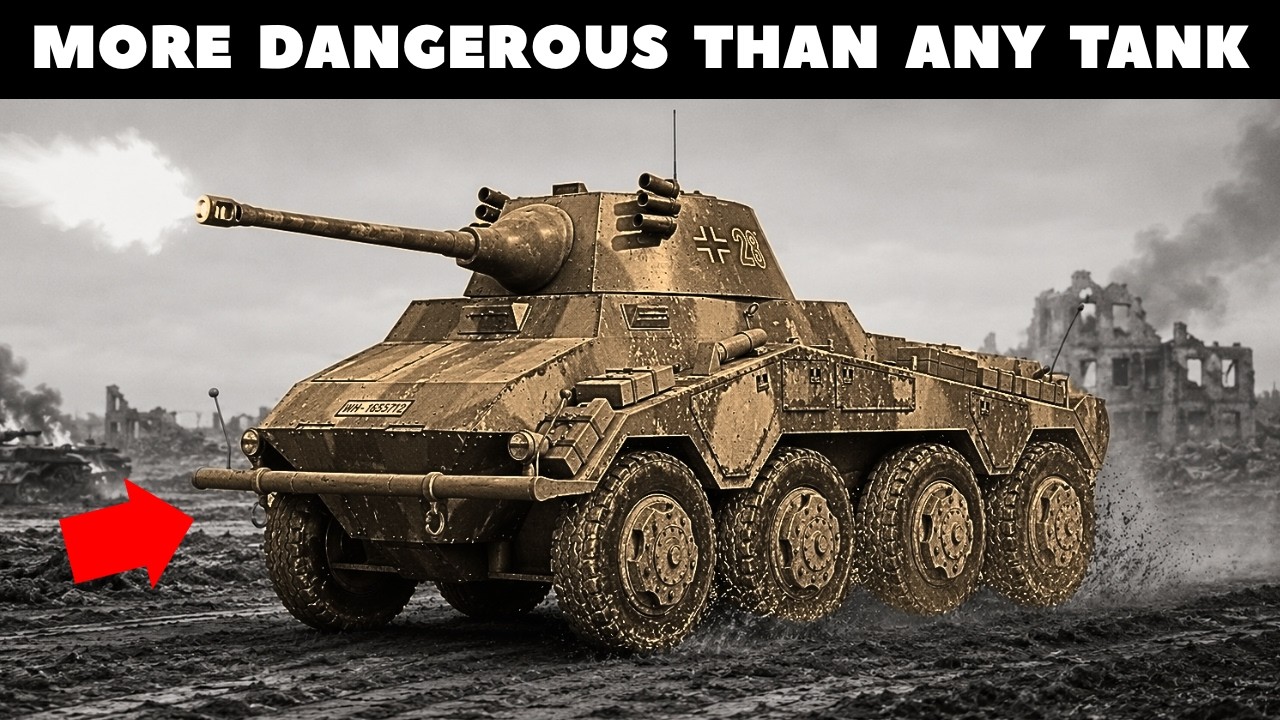
For dealing with infantry in close combat, this was more than enough. Now about the armor. And here begins the talk about compromises. The frontal armor of the turret and hull was 30 mm. By the standards of a light tank of early 1943, this was quite decent. The sides of the turret were 15 mm. The sides of the hull were 8 mm.
8 mm on the sides of the hull is not much. It is protection against rifle bullets and shrapnel, but not against large-caliber machine guns at close range. The designers understood this and made the compromise deliberately. Reducing weight meant preserving mobility. And mobility for a reconnaissance vehicle is more important than side armor.
At the same time, the gun mantlet, the very one called pig snout for its characteristic shape, had a thickness of 50 mm. This is a component that finds itself under fire first in battle. And they did not skimp here. 50 mm of frontal mantlet with 8 mm of hull sides is not a contradiction. It is a precise calculation.
Protect what will face the enemy and lighten everything else. The ammunition capacity of the gun was 55 shells, 27 high explosive and 28 armor piercing. The gun could hit light armored vehicles and most armored personnel carriers from a kilometer away. And at a distance of 500 m, it became dangerous for the Soviet T-34 medium tank.
Not guaranteed, not in just any projection, but dangerous is the exact word. On paper, the Puma looked like a reconnaissance commander’s dream. But how well did this dream work in real field conditions? Every combat vehicle lives in two dimensions. The first is technical characteristics on paper. The second is what happens when it leaves the factory gates and finds itself on real terrain, in real conditions, against a real opponent.
Let’s start with what the Puma did well. The vehicle’s transmission deserves a separate discussion. The Sonderkraftfahrzeug 234/2 was equipped with a six-speed preselector gearbox. Preselector means that the driver preselected the required gear, and the shift occurred with a single press of a pedal, without depressing the clutch in the usual sense.
Combined with a transfer case, a reduction gear for difficult conditions, this gave 24 speeds forward and the same number backward. 24 speeds backward is not a typo. Two control stations, reverse, transfer case. The vehicle moved equally confidently in both directions. Off-road capability and specific figures.
The Puma could handle a 30° slope, which is the angle of a fairly steep mountain road. It could overcome a vertical obstacle half a meter high, for example, the edge of a ditch or a broken curb. It could cross a ditch 2 m wide. It could ford water up to 120 cm deep. For a wheeled vehicle, these are serious indicators.
Not tank-like, but significantly better than those of any armored car on a commercial chassis. The speed on the highway was 90 km/h. On rough terrain, it was naturally less, but even there, the vehicle moved faster than most tracked vehicles of its time. Now, about the vulnerabilities. And here it is important to understand the context. The hull sides were 8 mm.
This is a fact that at first glance seems to be a serious disadvantage. A heavy machine gun from a close distance could penetrate such armor. An anti-tank rifle could, too. Any gun with a caliber of more than 20 mm could do so without question. But here we need to stop and think about what this machine was actually intended for.
The Puma is a scout. Its task is not to stand and take a hit, but to see the enemy before the enemy sees it. To operate at a distance. To retreat faster than the enemy has time to aim. 8 mm of side armor is not a design flaw. It is a conscious trade-off. Less armor in exchange for less weight and higher speed.
The same logic explains the open superstructures on other modifications of the Sonderkraftfahrzeug 234 family. Another real vulnerability was repair in field conditions. The vehicle was technically complex. The independent suspension of eight wheels, the preselector gearbox, the air-cooled diesel engine, all of this required qualified mechanics and special tools.
Unlike simpler vehicles, the Puma could not be repaired with improvised means on the side of the road. This was the flip side of technical sophistication. A comparison with contemporaries gives an idea of the scale. The American light tank M5 Stuart, which by that time had replaced the earlier M3A1, weighed 14 tons compared to the Puma’s almost 12.
It had thicker side armor, but was slower and had an incomparably shorter range. Soviet armored cars of the BA series were already going out of production by then. The concept of a three-axle armored car had exhausted itself. The Puma looked like a vehicle of another generation against their background, which in fact was true.
Theory is one thing, but the Puma fought on two fronts, and the results were unexpected. 101 vehicles. Exactly this many Pumas were produced during the entire production run. This is not a typo or an approximation. Exactly 101. To understand what this means on the scale of a real front, a single comparison is enough.
A standard tank battalion of that time consisted of 50 to 80 vehicles. That is, all the Pumas ever produced would barely make up one reinforced battalion. For two fronts, across thousands of kilometers of contact lines. These 101 vehicles were distributed among six formations. None of them received a sufficient number of Pumas to use them as an independent force.
Everywhere they operated as part of mixed reconnaissance units alongside other equipment. The Western Front, summer of 1944, Normandy. After the Allied landings in June 1944, heavy fighting for the bridgehead unfolded in northern France. Pumas operated here as part of the Leibstandarte Division and two Wehrmacht Panzer divisions.
Normandy is not an open step. It is hedgerows, narrow roads, and villages with stone walls. A terrain that choked maneuverability and neutralized the advantage in speed. In such conditions, a reconnaissance vehicle loses half its trump cards. You cannot make use of speed on a narrow road between hedgerows.
You cannot maintain distance when the enemy might be sitting around the next bend. And yet, the Pumas in Normandy made their mark. Their 50-mm guns were effective against American and British armored personnel carriers and light vehicles, which the Allies had in abundance. At a distance of up to a kilometer, the Puma confidently engaged any wheeled or light tracked enemy vehicle.
Winter of 1944 to 1945, the Ardennes. The German offensive in the Ardennes in December 1944 became the last major offensive operation on the Western Front. Pumas participated in it as part of the same formations. Here the conditions were different, cold, snow, and forested terrain. But the main problem remained the same, too few vehicles to influence the course of the operation.
The Eastern Front presented a different picture. As part of the 20th Panzer Division, Pumas fought in the area of Nevel and Kholm, the northwestern part of modern Russia. Then came Bobruisk in the summer of 1944 during the heavy defensive battles of the Soviet offensive known as Operation Bagration.
Later, Breslau, Nysa, and Prague. The vehicles went from east to west through the entire final phase of the war. On the Eastern Front, the Puma had one major advantage over the Western Front, space. The open terrain allowed it to utilize its speed and detection range. A scout can work as a scout only when it has the opportunity to keep its distance.
But here, too, the main limitation of quantity made itself felt. 101 vehicles for two fronts. Even with the high quality of each individual unit, this number was too small to change anything on a strategic level. Pumas could win individual clashes. They could work successfully in reconnaissance.
They could inflict precise damage on the enemy. But to turn the tide of events, no. For this, not units or dozens were needed. Hundreds were needed. Production of the Puma was stopped. But the reason was not that the vehicle turned out to be bad. The reason lay elsewhere. September 1944. Production of the Puma is stopped after 101 units are produced.
The assembly line is switched to the first and third modifications of the Sonderkraftfahrzeug 234. No official explanation was ever published, but if you gather the facts together, the picture emerges on its own. There were several reasons, and each of them individually would have been sufficient.
The first reason was the disappearance of the target. The Puma was created as a reconnaissance vehicle with anti-tank capabilities. Its 50-mm KwK 39 gun with a barrel length of 60 calibers was dangerous for light tanks from a kilometer away and for medium tanks at a distance of about 500 m. In early 1943, when the vehicle was designed, this made sense.
Light tanks were everywhere among opponents. But by the end of 1943, the Soviet army had completely stopped the production of light tanks. The T-70 tank, the last mass-produced Soviet light tank, rolled off the assembly line. The emphasis was placed on medium and heavy machines, the T-34 in various modifications and the IS-2 heavy tank.
Against them, the 50-mm gun was effective only under very specific conditions. From close range, into the side, and at a favorable angle of impact. American light tanks had also changed. The M5 Stuart tank, which replaced the M3A1, received noticeably thicker armor compared to its predecessor. Engaging it became more difficult.
The 50-mm gun for which the Puma was created was losing its relevance right before everyone’s eyes. The second reason was tungsten. Here, a brief explanation is needed. Armor-piercing shells can be different. An ordinary steel shell penetrates armor through kinetic energy and the hardness of the steel. A sub-caliber shell with a tungsten core works differently.
Tungsten is significantly heavier and harder than steel, which at the same shell speed gives several times greater penetration capability. For a long-barreled 50-mm gun, a sub-caliber shell with a tungsten core was what made it truly dangerous for medium tanks. Without it, the gun’s capabilities were sharply narrowed.
Germany by this time was experiencing an acute shortage of tungsten. The main suppliers of this metal, Portugal and Spain, under pressure from the allies, were gradually winding down trade with Germany. Stocks were melting. The production of sub-caliber shells with a tungsten core for 50-mm guns was officially discontinued.
Without these shells, the 50-mm KwK 39 gun became a weapon of limited effectiveness against armor. An entire family of guns lost its main trump card due to the shortage of a single metal weighing a few grams per shell. The third reason was the economics of production. The Puma was a complex machine.
A monocoque hull, eight independent suspensions, a preselector gearbox, and a specific diesel engine. All of this required skilled labor, precise equipment, and time. By the autumn of 1944, the German military industry was operating under conditions of constant disruption, shortages of materials, damaged factories, and a deficit of working hands.
In such conditions, a complex, expensive machine in small quantities lost out to simpler and cheaper solutions. The first modification of the Sonderkraftfahrzeug 234 with a 20-mm gun covered reconnaissance tasks. The third and fourth modifications with more powerful armament covered fire support and anti-tank combat tasks.
The Puma found itself caught between these tasks. Too specialized for its quantity to matter, too complex to be produced in the required volumes. Production was stopped. But the idea it embodied did not go anywhere. It was simply waiting for its time. May 1945. The last Pumas are either abandoned by their crews, captured by Allied forces, or destroyed in the final battles.
The vehicle lived in serial production for less than a year, only 101 units. By the standards of wartime production, a negligible number. It would seem the story is over. But this is exactly where its most interesting part begins. The victors carefully studied the captured equipment.
British, American, and Soviet engineers examined captured specimens of the Sonderkraftfahrzeug 234 with professional interest. Monocoque hull, independent suspension of eight wheels, two control stations, air-cooled diesel engine, preselector gearbox. Each of these elements was recorded, measured, and studied. There was no direct copying.
Post-war armies solved other tasks under other conditions. But the principles laid down in the Sonderkraftfahrzeug 234 family began to manifest themselves in new designs. First slowly, then more and more obviously. A monocoque without a frame is today a standard for all wheeled armored vehicles.
Not a single modern combat wheeled vehicle is built on a separate load-bearing frame. This solution, tested on the Sonderkraftfahrzeug 234 in 1943, became universal. All-wheel drive on all axles with independent suspension is also a standard. Also a norm. Also something that is perceived today as obvious and taken for granted.
But the main idea, a wheeled vehicle with a turret and a gun capable of working on equal terms with light and medium armored vehicles, this idea took much longer to be realized. A full-fledged wheeled tank, a vehicle on a wheeled chassis with a closed turret, serious armor, and a gun capable of fighting tanks, is a concept that the world was able to embody in metal only in the 1980s and ’90s.
The French AMX-10RC wheeled tank with a 105-mm gun, the Italian Centauro, eight wheels, a 105-mm gun, and a combat weight of about 25 tons, the American Stryker in various armed modifications, the South African Rooikat, the Japanese Type 16 maneuver combat vehicle. All of them are direct heirs to the idea that German engineers embodied in the Puma in 1943.
Wheels instead of tracks, speed and range instead of maximum protection, strategic mobility as the main advantage. The difference is that modern vehicles weigh two to three times more than the Puma and carry guns of twice the caliber. But the principle is the exact same. Why the wheeled tank became so widespread at the end of the 20th century is a separate question.
Partly, this is due to a change in the nature of conflicts. The emphasis shifted to rapid deployment, transport over long distances, and operations in urban environments. A wheeled vehicle is loaded into a transport aircraft much more easily than a tracked one. It can be driven under its own power for hundreds of kilometers without wear on the running gear.
It is cheaper to operate. All of this was true in 1943 as well. German designers understood this. It was just that the world was not yet ready to accept this idea in its entirety. 101 Pumas did not change the course of history. This is an honest fact and it should not be embellished. Too few machines, too late, in too difficult circumstances.
But the engineering idea they embodied turned out to be correct. So precise that half a century later, the whole world began to build machines based on the same principles. With more powerful engines, thicker armor, and larger guns, but based on the same principles. There is a special irony in the fact that a concept born in conditions of severe resource shortages and military necessity became one of the main directions for the development of armored vehicles in peacetime.
The Puma was not just an armored car. It was a blueprint of the future drawn 70 years ahead of its time. And the fact that this blueprint was drawn under conditions that did not favor long-term planning makes the engineering achievement only more impressive. Ideas do not have an expiration date, especially correct ideas.
Thank you for watching. See you soon.