German Panzers Surrounded Them At Minqar Qaim — Then The New Zealanders Did The Unthinkable D
It’s just past 2:00 in the morning in the Egyptian desert and a few thousand men are quietly fixing bayonets in the dark. In front of them sits a German tank, then another, a whole ring of them parked in a circle with their engines cooling and their crews half asleep. Behind the men with the bayonets, stretching back into the blackness, are hundreds of trucks, not tanks, not armored cars, soft, thin-skinned supply trucks packed with wounded and exhausted soldiers, their engines idling low.
And in a few minutes, on a single order, every one of those trucks is going to switch on and drive straight through the middle of a German armored division. It sounds like a suicide note. It became one of the boldest escapes in the history of the New Zealand military and one of the most bitterly argued over to this day.
To understand how an entire division ended up betting its survival on a bayonet charge against tanks, you have to back up a few days to a war that was falling apart. It’s late June 1942, North Africa. Rommel has just done the unthinkable himself. He’s taken Tobruk, the fortress the Allies swore would never fall.
And now he’s chasing a broken Eighth Army back toward Cairo and the Suez Canal. The British line is collapsing in slow motion. Whole units are being swallowed. And into this mess gets thrown the Second New Zealand Division, freshly recalled from garrison duty in Syria and shoved into the path of the avalanche.
Their commander is Major General Bernard Freyberg, a huge man scarred from the last war, the kind of officer who walks the front line on foot to see things for himself. The High Command wants him to dig in at a coastal town called Mersa Matruh. Freyberg takes one look at the position and hates it.
He calls it a trap with no way out, a box where a fast-moving enemy could pin him against the sea and grind him to nothing. So, he does something about it. He pulls his men south, away from the coast, onto a long stony ridge in the open desert. The place is called Miteiriya Qaim. Out here, he has room to move, room to fight on his own terms, room to run if it comes to that.
A senior British general even visits and tells him not to worry too much. The position isn’t vital, and if things get hot, he can simply slide east and slip away. That was the plan. The enemy had other ideas. Through the 27th of June, the dust on the horizon stops being dust. It’s vehicles.
It’s the 21st Panzer Division swinging wide and fast around the New Zealand flank. One by one, the escape routes close. The British armor that’s supposed to be guarding the edges pulls back and leaves the Kiwis hanging in the open. By the afternoon, the ridge at Miteiriya Qaim is surrounded on every side. 10,000 men cut off in the middle of the desert with the most dangerous army on the continent tightening around them.
From the German side, the math is simple. The division is trapped. It’s out of position, low on supplies, and ringed by tanks. There’s nothing left for it to do but die in place or put its hands up. And then, late in the day, the one man holding the whole thing together caught a piece of red-hot steel in the throat.
The artillery had been working the ridge all day. There’s no cover to speak of at Miteiriya Qaim. Just rock and scrub and a lower escarpment and across it the German guns walked their shells back and forth hour after hour. While the New Zealanders pressed themselves into shallow scrapes in the ground and waited.
Freyberg wouldn’t stay down. He kept moving among the forward positions checking on his men the way he always did. And that’s where a shell splinter found him tearing into his neck. Suddenly the division didn’t have its commander. Command fell to Brigadier Lindsay Inglis, a sharp-tongued lawyer in uniform known to the men by the nickname Whiskey Bill.
Inglis inherited the worst situation a soldier can imagine. Surrounded, his general down, ammunition and water running low, daylight fading, and not a single friendly unit close enough to break in and save them. He had two choices and only two. The first was surrender. It was the reasonable option. It was what the textbook and arguably common sense said to do.
Thousands of men would live. They’d spend the war behind wire, but they’d live. The second choice was the one nobody sane would pick. Attack in the dark straight into the strongest part of the ring. Smash a hole through a tank division with infantry on foot and then shove the entire division, trucks, wounded, headquarters, everything through that hole before the enemy understood what was happening.
Inglis picked the second one. The plan he built that evening reads like something out of a fever dream. The fourth brigade would lead. Three battalions of infantry would form up in the dark and walk straight at the German lager. That circle of parked tanks and sleeping crews. And they would not soften it up first.
No artillery barrage, no warning. The one and only advantage the New Zealanders had left was surprise, and a barrage would throw it away. So, the men would close the distance in silence and open the fight at point-blank range with rifles, grenades, and steel. Behind the infantry, once the hole was torn open, the rest of the division would pour through the gap.
Divisional headquarters, the 5th Brigade, and the long vulnerable column of transport. Hundreds of trucks. The order to the drivers would be brutally simple when it came. Full speed, straight ahead. Stop for nothing and no one. Think about what that actually meant. Infantry charging armor.
Unarmored trucks running a gauntlet through the heart of a Panzer division at night. Every principle of modern mechanized war said it should end in slaughter. Among the company commanders waiting to lead that charge was a quiet, stubborn captain from the 20th Battalion. He already wore the Victoria Cross, Britain and the Commonwealth’s highest award for bravery, earned the year before on Crete.
His name was Charles Upham. Remember him. We’ll come back to him in the dark. The attack was set for midnight. Midnight came and went, and the men crouched in the rocks waiting for the order that didn’t come because one of the battalions hadn’t arrived yet. The delay would shove them straight into the most savage close-quarters fighting the division would ever see.
The order finally came at 2:00 in the morning. The start pushed back by the late arrival of the Maori Battalion. There was no more waiting. Three battalions of the 4th Brigade rose out of the rocks and started down off the escarpment into the black desert toward an enemy they couldn’t see. They moved without a sound.
No talking, no shooting, just hundreds of men walking into the dark with bayonets fixed, closing on a sleeping army. For about a mile and a half, nothing. And then they walked straight into it. A leaguer of around a dozen German tanks parked close together, their crews resting beside them. The New Zealanders were on top of the position before most of the Germans even understood they were under attack.
What happened next is almost impossible to picture cleanly because the men who lived through it could barely describe it themselves. The night came apart. Muzzle flashes strobed across the dark. Bren gunners fired from the hip as they walked. Grenades cracked among the tanks.
Men screamed orders and warnings in two languages at once. And friend and enemy were so close together that you could reach out and touch the man you were trying to kill. Where there wasn’t time to fire and often there wasn’t it came down to the bayonet. Cold steel in the dark, hand-to-hand, the oldest and ugliest kind of fighting there is.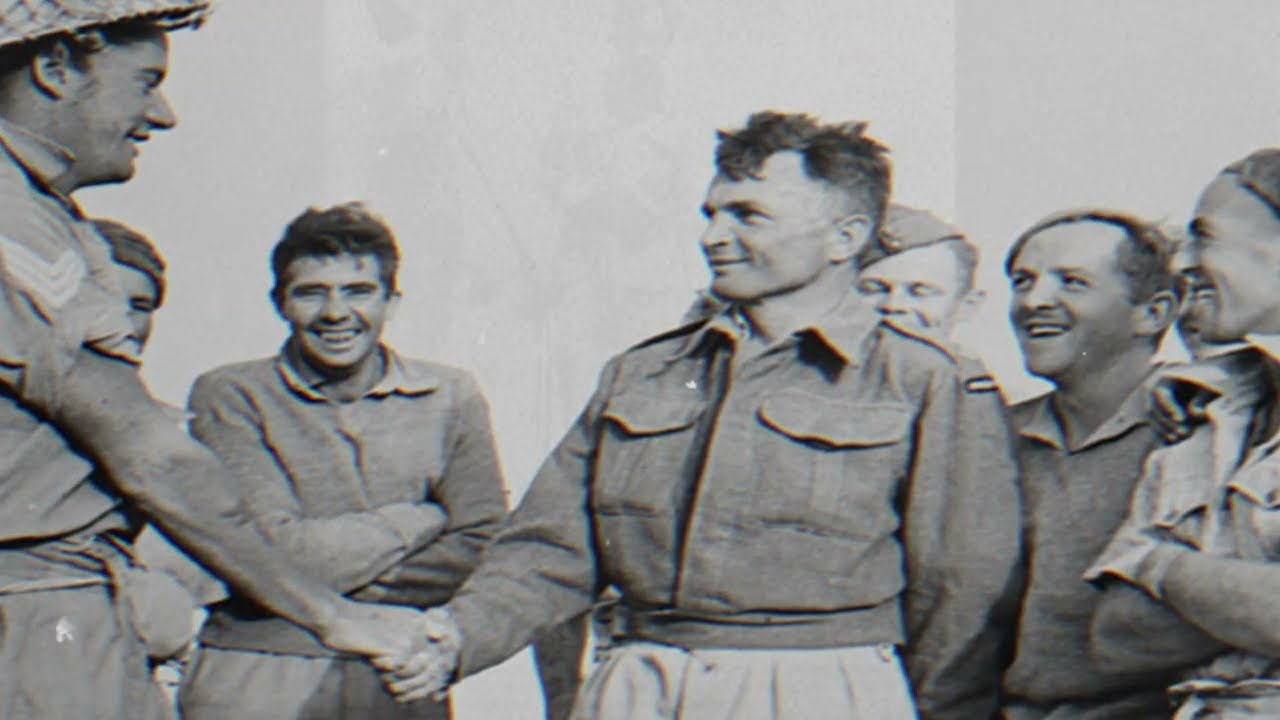
Most of the Germans had been caught in their slit trenches, half awake, fumbling for weapons. The shock and the speed and the sheer aggression of the thing carried the New Zealanders forward through the chaos. And in the middle of it was Captain Charles Upham. He led from the front the way he always did, overrunning one enemy position after another, dragging his company through the confusion by sheer force of will.
Then his men ran up against a German truck packed with soldiers. Upham and one of his men went straight at it with hand grenades. They destroyed the truck and everyone in it. And the blast was so close that Upham was wounded by fragments of his own bombs, steel from his own grenades tearing into him as he threw.
He kept going anyway. What Upham did that night and in the weeks that followed would eventually earn him something almost no soldier in all of history has ever received. But that recognition was years away and far from guaranteed. And on that night, it was the furthest thing from his mind. Hold that thought.
It pays off before we’re done. Because somewhere in that churning, screaming dark, the New Zealanders overran something they never meant to touch. And what happened there would follow this story for the next 80 years. While the infantry tore the hole open, the rest of the division got ready to run for it. Word went down the long line of vehicles. This is it. Full speed.
Don’t stop. Not for breakdowns, not for fire, not for the wounded, not for anything. The gap won’t stay open. Drive through it. And then hundreds of trucks switched on at once and surged forward into the night. Picture it from the inside. The dust comes up in a thick brown wall, so dense the drivers can’t see the truck in front of them.
Only the faint shape of it and the glow of fires. Tracer rips across the column from both sides. Vehicles burn. The noise is total. Engines screaming, guns hammering, men shouting. And through all of it, the trucks just keep coming. A flood of them pouring through the breach the infantry bought with the bayonet, refusing to slow down, refusing to stop.
Freyberg himself went through it like that. The wounded general laid in an improvised ambulance driven straight through the middle of the enemy. The vehicle carrying him was hit by fire twice on the way out, and twice it kept rolling. This is where the story turns dark, and an honest telling can’t look away from it.
In the confusion of that night fight, the New Zealanders overran a German medical position, an aid station full of wounded men and the people treating them. And in the frenzy of the darkness, accounts record that wounded and surrendering Germans were bayoneted. It is the single most controversial thing that happened at Minqar Qaim, and it has never been cleanly settled.
The German side called it an atrocity. Defenders point to the reality of the moment, pitch-black, point-blank range, exhausted men who’d been shelled all day, fighting for their lives in a chaos where a raised hand couldn’t be seen, and a surrender couldn’t be trusted. Both of those things are true at once.
The courage and the brutality happened in the same hour, on the same ground, often carried out by the same men. That contradiction is part of what the night actually was, and pretending otherwise would be a lie. By the first gray light of the 28th of June, it was done. The bulk of the division had smashed clean through the German ring and was streaming east across the open desert, away from the trap, toward the Allied line forming up at a railway halt most people had never heard of.
A place called El Alamein. They’d done the impossible. They’d gotten out. But what that escape cost, and what it quietly decided about the entire war in Egypt, is the part that almost never gets told. Here’s the thing that historians still find hard to believe. The breakout itself was, against every reasonable expectation, relatively cheap in lives.
One of the lead battalions, the 20th, lost just 13 men killed punching through the German lines. For an operation that by rights should have ended in massacre, infantry against armor, soft trucks through a panzer division, getting most of 10,000 men out the other side was an extraordinary result. That’s not the whole bill, and honesty matters here.
The wider battle around Mersa Matruh cost the division close to a thousand casualties. And across the brutal weeks that followed, from late June into July, the New Zealanders bled badly. Well over 4,000 men killed, wounded, or taken prisoner in that stretch of desert fighting. Minkar Qaim was a triumph, but it sat in the middle of one of the hardest summers the division ever endured.
So, was it worth it? Look at what survived. If that division had been destroyed on the ridge, if Inglis had raised his hands instead of his bayonets, the Eighth Army would have lost one of the most effective fighting formations it had at the exact moment it could least afford to. Instead, the men who carved their way out at Minkar Qaim were the same men who, only weeks later, helped hold the line when Rommel threw himself at El Alamein and was finally, permanently stopped.
The breakout didn’t just save 10,000 soldiers. It preserved a force the Allies needed to turn the entire war in North Africa. And then there’s Charles Upham. Remember the captain who destroyed a truckload of enemy soldiers with grenades and got wounded by his own steel doing it? He fought on through that desperate summer, was wounded again, and was eventually captured.
After the war ended and he came home, the question of what to do about his bravery came back around. His own side had been quietly gathering evidence for years because what he’d done deserved more than a footnote. When the recommendation reached King George the VI that Upham should receive a bar to his Victoria Cross, a second VC, something almost never done, the king hesitated.
He turned to the New Zealand general who knew Upham’s record, Howard Kippenberger, and asked him plainly, “Does he deserve it?” Kippenberger’s answer has outlived almost everything else from that war. “In my respectful opinion, sir,” he said, “Upham won the VC several times over.” The bar was confirmed in 1945.
To this day, Charles Upham remains the only fighting soldier in history ever to win the Victoria Cross twice. And the night he started earning that second one was the night his division did the unthinkable at Minqar Qaim. That’s how it’s remembered now, as one of the finest things the New Zealanders ever did and one of the most troubling.
A division that should have surrendered and instead charged tanks with bayonets. A breakout that saved an army and shadowed itself with an atrocity in the same few hours of darkness. Heroism and horror, survival and cost, all of it tangled together on one stretch of desert and impossible to pull apart.
They were surrounded by German Panzers at Minqar Qaim. They were supposed to give up. They did the unthinkable instead and drove out the other side of it into history.